Showing posts with label strategy. Show all posts

The Discipline of Market Leaders: Choose Your Customers, Narrow Your Focus, Dominate Your Market Review

The Discipline of Market Leaders: Choose Your Customers, Narrow Your Focus, Dominate Your Market
Average Reviews:

(More customer reviews)
This book's concepts for strategic marketing management are so widely accepted that the popular Balanced Scorecard concept of Kaplan and Norton in 2001 decided to adopt the ideas for the "customer perspective".
The authors manage to take Michael Porter's two generic competitive strategies - Differentiation and Cost Leader - and elaborate on these to an extent never presented so elegantly before. In the process, they discover a third generic strategy - Customer Intimacy.
Thus, Treacy and Wiersema distinguish between focusing on the following value dimensions:
- Operational excellence (cost leadership / focus on supply chain management)
- Product leadership (innovation / focus on product lifecycle management)
- Customer Intimacy (service leadership /focus on customer relationship management)

These are the FOUR RULES that govern market leaders' actions:
Rule 1: Provide the best offering in the marketplace by excelling in a specific dimension of value
Rule 2: Maintain threshold standards on the other dimensions of value
Rule 3: Dominate your market by improving value year after year
Rule 4: Build a well-tuned operating model dedicated to delivering unmatched value
Expanding on the fourth rule - operating models - may the best long-term contribution of this book. The authors explain in detail and via case stories how the operating models differ for each of the three value propositions. In practice, I've learned that by explaining the operating models, many people can easier find themselves depicted than in the overall generic dimensions of cost, service or product leadership.
OPERATIONAL EXCELLENCE or Cost Leadership - Best total cost - operating model:
Key success factor: Formula!
Golden rule: Variety kills efficiency
Culture: Disciplined teamwork; Process focused; Conformance, "one size fits all" mindset
Organization: Centralized functions; high skills at the core of the organization
Core processes: Product delivery and basic service cycle; built on standard, no frills fixed assets
Management Systems: Command and control; Compensation fixed to cost and quality; transaction profitability tracking
Information Technology: Integrated, low-cost transaction systems; Mobile and remote technologies
PRODUCT LEADERSHIP - Best product - operating model:
Key success factor: Talent!
Golden rule: Cannibalize your success with breakthroughs
Culture: Concept, future driven; Experimentation, "out of the box" mindset; Attack, go for it, win
Organization: Ad-hoc, organic, and cellular; High skills abound in loose-knit structures
Core processes: Invention, Commercialisation; Market exploitation; Disjoint work procedures
Management Systems: Decisive, risk oriented; Reward individuals' innovation capacity; Product lifecycle profitability
Information Technology: Person-to-person communications systems; Technologies enabling cooperation and knowledge management
CUSTOMER INTIMACY - Best total solution - operating model:
Key success factor: Solution!
Golden rule: Solve the client's broader problem
Culture: Client and filed driven; Variation: "Have it your way" mindset
Organization: Entrepreneurial client teams; High skills in the field
Core processes: Client acquisition and development; Solution development; Flexible and responsive work procedures
Management Systems: Revenue and share-of-wallet driven; Rewards based in part on client feedback; Lifetime value of client
Information Technology: Customer databases linking internal and external information; Knowledge bases built around expertise
If you're interested in Customer Intimacy, you may want to add Wiersema's additional book on only this strategy to your shopping basket. I highly recommend both paperback books ... great value for money ;-)
Peter Leerskov,
MSc in International Business (Marketing & Management) and Graduate Diploma in E-business

Click Here to see more reviews about: The Discipline of Market Leaders: Choose Your Customers, Narrow Your Focus, Dominate Your Market

Why is it that Casio can sell a calculator more cheaply than Kellogg's can sell a box of corn flakes? Why can FedEx "absolutely, positively" deliver your package overnight but airlines have trouble keeping track of your bags? What does your company do better than anyone else? What unique value do you provide to your customers? How will you increase that value next year? As customers' demands for the highest quality products, best services, and lowest prices increase daily, the rules for market leadership are changing. Once powerful companies that haven't gotten the message are faltering, while others, new and old, are thriving. In disarmingly simple and provocative terms, Treacy and Wiersema show what it takes to become a leader in your market, and stay there, in an ever more sophisticated and demanding world.

Buy Now

Click here for more information about The Discipline of Market Leaders: Choose Your Customers, Narrow Your Focus, Dominate Your Market

Read More...

Thick Face, Black Heart: The Warrior Philosophy for Conquering the Challenges of Business and Life Review

Thick Face, Black Heart: The Warrior Philosophy for Conquering the Challenges of Business and Life
Average Reviews:

(More customer reviews)
Rarely does a book come along that gets labled "companion", but Thick Face Black Heart is just that. Like Gracian's "The Art of Wordly Wisdon", this book is a companion for life. To be read and re-read.
I searched and read for a long time differing books on succeeding in life. I bought this book based on a comment from a reviewer inside which said, "If I had to carry only two books on a runway it would be Sun Tzu's Art of War and Thick Face Black Heart."
Being a huge long time fan of SunTzu, I figured I had to give this book a chance. It was one of the best decisions I have made.
The clarity into how life works whether you like it or not is worth the cost alone. Too many people (myself included) have a hard time believing that the world (and life) itself is a battlefield. This illumination will not depress you - in fact it will rejuvinate you.
My copy is dog-eared to no end. I read it through at least twice a year and keep it by my bed (whether at home or on the road).
This is not money wasted.
The best compliment I can give about this book? After having read Thick Face Black Heart the first time, I threw all other self-help books I owned (Tony Robbins included)in the trash. I haven't missed them since.

Click Here to see more reviews about: Thick Face, Black Heart: The Warrior Philosophy for Conquering the Challenges of Business and Life

Chin-Ning Chu is one of the world's foremost experts on Asian business psychology, a frequent guest on "Larry King Live" and other high-profile TV shows. Now he shows how to apply ancient Chinese military wisdom to the competitive world of business today. "Could become the Think and Grow Rich of the 1990s".--Success magazine.

Buy Now

Click here for more information about Thick Face, Black Heart: The Warrior Philosophy for Conquering the Challenges of Business and Life

Read More...

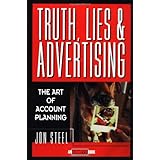
Truth, Lies and Advertising : The Art of Account Planning Review

Truth, Lies and Advertising : The Art of Account Planning
Average Reviews:

(More customer reviews)
Goodby-Berlin may well be the best advertising agency in world at this time. Jon Steele's introduction of account planning there may well be the main reason. The proven formula: original consumer insights help create more powerful ads for greater results. Steele's work has consistently produced successes like the "Got Milk?" campaign.
Steele's approach is rare in the advertising world for several reasons: it shows humility and common sense, honors listening to the consumer with imagination, acknowledges the importance of creative quality, is mercifully free of self-promotion, and states the limits of account planning (sometimes there are simply no insights to be found).
While this is not a "how-to" book, I particularly enjoyed some of the tools and tactics: asking focus group participants to go weeks without milk and report back on what they had missed; asking drivers to fill in a thought balloon when they see the driver of a particular brand of car.
When I was done reading the book I felt as if I had just had a witty and interesting conversation with an intelligent and insightful person. I have been sharing the book with my advertising partners ever since.

Click Here to see more reviews about: Truth, Lies and Advertising : The Art of Account Planning

"Account planning exists for the sole purpose of creating advertising that truly connects with consumers. While many in the industry are still dissecting consumer behavior, extrapolating demographic trends, developing complex behavioral models, and measuring Pavlovian salivary responses, Steel advocates an approach to consumer research that is based on simplicity, common sense, and creativity--an approach that gains access to consumers' hearts and minds, develops ongoing relationships with them, and, most important, embraces them as partners in the process of developing and advertising.
A witty, erudite raconteur and teacher, Steel describes how successful account planners work in partnership with clients, consumer, and agency creatives. He criticizes research practices that, far from creating relationships, drive a wedge between agencies and the people they aim to persuade; he suggests new ways of approaching research to cut through the BS and get people to show their true selves; and he shows how the right research, when translated into a motivating and inspiring brief, can be the catalyst for great creative ideas. He draws upon his own experiences and those of colleagues in the United States and abroad to illustrate those points, and includes examples of some of the most successful campaigns in recent years, including Polaroid, Norwegian Cruise Line, Porsche, Isuzu, "got milk?" and others.
The message of this book is that well-thought-out account planning results in better, more effective marketing and advertising for both agencies and clients. And also makes an evening in front of the television easier to bear for the population at large."

Buy Now

Click here for more information about Truth, Lies and Advertising : The Art of Account Planning

Read More...

Flash Foresight: How to See the Invisible and Do the Impossible Review

Flash Foresight: How to See the Invisible and Do the Impossible
Average Reviews:

(More customer reviews)

In this book written with John David Mann, Daniel Burrus discusses a skill that uses "the data of your five senses, as well as that intuitive sixth sense we all have that some call a gut feeling or hunch. But flash foresight goes further, because in using it you synthesize those sensory and intuitive faculties and project them forward through the dimensions of time. A flash foresight is a blinding flash of the future obvious. It is an intuitive grasp of the foreseeable future that, once you see it, it reveals hidden opportunities and allows you to solve your biggest problems - before they happen. Flash foresight will allow anyone to both see and shape his or her future."
How valuable would someone be to an organization if she or he mastered that skill? How valuable would a team be if all of its members had mastered that skill? How to do that? Burrus explains the process in his book.
More specifically, he suggests that there are seven "triggers," any one or several of which can produce a flash foresight:
1. Start with Certainty (i.e. identify and verify hard trends)
2. Anticipate (i.e. determine degree of probability of relevant contingencies)
3. Transform (i.e. leverage technology-driven change)
4. Skip what you think is your biggest problem (in fact, it isn't...and never was)
5. Go opposite (e.g. look where no one else does, see what no one else sees, do what no one else does)
6. Redefine and reinvent (i.e. leverage your unique strengths in new and better ways)
7. Direct your future (or have someone else will do it for you)
Zappos offers an excellent example. Its leaders were certain that online sales would continue to increase and that it was probable that the process of purchasing commodities would be more important to the consumer than the products themselves would be. They concluded that the most efficient operations (e.g. order processing) would be driven by high technology and that returns rather than sizing was its biggest problem. They defied conventional wisdom that that selling shoes online could not be profit. Until Zappos, that was true.
As for #6, consider these comments by CEO Tony Hsieh: "We hope that ten years from now, people won't even realize that we started out selling shoes online, and that when you say `Zappos,' they'll think, `Oh, that's the place with the absolute best service.' And that doesn't even have to be limited to being an online experience. We've had customers email us and ask if we would please start an airline or run the IRS."
Years ago, Oliver Wendell Holmes said that he "didn't care a fig about simplicity this side of complexity" but that he would "give his life for simplicity on the other side of complexity." Daniel Burrus would make the same claim for serendipity. I think his Flash Foresight may well prove to be the best business book published in 2011. Is it that good? Yes.

Click Here to see more reviews about: Flash Foresight: How to See the Invisible and Do the Impossible


Buy Now

Click here for more information about Flash Foresight: How to See the Invisible and Do the Impossible

Read More...

The Innovator's Prescription: A Disruptive Solution for Health Care Review

The Innovator's Prescription: A Disruptive Solution for Health Care
Average Reviews:

(More customer reviews)
It is a commonplace that the U.S. healthcare system is broken, but the discussion often degenerates into a debate about who is responsible. This book takes a different approach, focusing on what is wrong with the healthcare system and needs to change so it can work better.
The proposed solution is to discard the current fee for healthcare service model, in which healthcare providers are systematically paid to treat illness without recompense for fostering welfare, and create a three-track system:
(1)Fee for service would continue to apply to diagnostic services, where - due to the nature of the patient's condition and the state of medical knowledge - there is a high need for intuitive investigation versus results-based treatment for conditions that are well understood. (The process described brings to mind episodes of House, a TV show in which a brilliant but irascible doctor challenges a team of colleagues to find the problem before the patient dies.)
(2) Fee for result would apply for treating conditions that are well understood and have a clearly defined solution -- colonoscopies, laser eye surgery, implantation of stents, etc.
(3)User networks for patients with chronic conditions/ unhealthy practices to learn how they can help themselves and be motivated to do so.
As is pointed out again and again, disruptive changes will be needed to get from A to B. Thus, hospitals must be redirected to focus on diagnostic services and cede provision of standardized care and wellness coordination to specialized clinics and other agencies. Primary care physicians (the traditional "family doctor") should concentrate on diagnostic services at a lower level rather than acting as "gatekeepers" for referrals to specialists. Enabling changes in reimbursement rules, health insurance arrangements, and medical record keeping are spelled out in detail.
When the dust settles, there will be fewer hospitals (with the survivors focused on enhanced diagnosis, like the Mayo Clinic), fewer medical specialists (who currently operate in narrow niches, often without a full grasp of a patient's situation), more primary care physicians and nurses with augmented responsibilities, a new model for pharmaceutical companies that focuses on targeted medications for precisely defined conditions versus the development and marketing of "blockbuster" drugs that only help a fraction of the users and require enormously expensive mass clinical trials, and a lot of medical work performed by less highly trained personnel with better diagnostic tools.
Andy Kessler presented an analogous vision in "The End of Medicine: How Silicon Valley (and Naked Mice) Will Reboot Your Doctor," Harper Collins (2006). His book is very entertaining, but this one covers the ground in a more disciplined and comprehensive manner. I would recommend "The Innovator's Prescription" for anyone who is seriously concerned about the current healthcare system.
Doctors, hospitals, and other healthcare providers cannot make the needed changes on their own, because they do not control all the levers. Having the government take the lead is said to be problematic, for reasons that are dispassionately stated and I happen to agree with. The authors suggest that the best candidate entities for leading the transition to healthcare in the new mode might be employers that profit from the good health of their employees. Then there is the intriguing possibility of expanding the role of integrated healthcare providers,e.g., Kaiser Permanente.
Let's hope our country chooses the right path.

Click Here to see more reviews about: The Innovator's Prescription: A Disruptive Solution for Health Care


A groundbreaking prescription for health care reform--from a legendaryleader in innovation . . .

Our health care system is in critical condition. Each year, fewer Americans can afford it, fewer businesses can provide it, and fewer government programs can promise it for future generations.

We need a cure, and we need it now.

Harvard Business School's Clayton M. Christensen—whose bestselling The Innovator's Dilemma revolutionized the business world—presents The Innovator's Prescription, a comprehensive analysis of the strategies that will improvehealth care and make it affordable.

Christensen applies the principles of disruptive innovation to the broken health care system with two pioneers in the field—Dr. Jerome Grossman and Dr. Jason Hwang. Together, they examine arange of symptoms and offer proven solutions.

YOU'LL DISCOVER HOW
"Precision medicine" reduces costs and makes good on the promise of personalized care
Disruptive business models improve quality, accessibility, and affordability by changing the way hospitals and doctors work
Patient networks enable better treatment of chronic diseases
Employers can change the roles they play in health care to compete effectively in the era of globalization
Insurance and regulatory reforms stimulate disruption in health care


Buy Now

Click here for more information about The Innovator's Prescription: A Disruptive Solution for Health Care

Read More...