Showing posts with label management. Show all posts

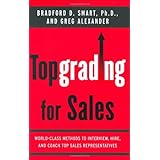
Topgrading for Sales: World-Class Methods to Interview, Hire, and Coach Top SalesRepresentatives Review

Topgrading for Sales: World-Class Methods to Interview, Hire, and Coach Top SalesRepresentatives
Average Reviews:

(More customer reviews)
Following the advice of a reviewer I did not pay full price for this book, I paid $2.92 plus shipping. The book is an easy read with its 54 pages and another 50+ pages of appendixes. Topgrading is a thorough and extensive selection system for hiring top performing people, in the case of this particular book, sales representatives. The problem is that you keep waiting for some real substance beyond the proposed premise of don't hire anybody unless they are the best. The system is quite elaborate in the information you are asked to collect, but you are never given any method for evaluating or how to use this information. They just keep saying that people using their system have much fewer washouts and more high achievers. Reading it was like watching those late night 60-minute infomercials.

Click Here to see more reviews about: Topgrading for Sales: World-Class Methods to Interview, Hire, and Coach Top SalesRepresentatives

A concise extension of the business classic Topgrading, targeted to sales managers Brad Smart's Topgrading has sold more than 150,000 copies since 1999, making it the definitive book for executives who want to hire, coach, and retain top talent. Now Smart has teamed up with Greg Alexander, who used Topgrading to radically improve his sales force at EMC. In Topgrading for Sales, they have boiled down the key Topgrading ideas to a pithy 112 pages while focusing on the unique needs of sales managers and sales directors. Great sales forces don't just depend on strategies— they depend on hiring the best possible reps. But surveys show that about half of all hires and promotions put an underqualified person in the wrong job. No wonder the average tenure for sales managers is only nineteen months. Topgrading for Sales takes the guesswork out of hiring by teaching readers how to interview systematically for A-level talent instead of relying on hunches and prejudices. It also shows how to coach B-level reps to turn them into A-players and how to weed out C-players before they do too much damage.

Buy Now

Click here for more information about Topgrading for Sales: World-Class Methods to Interview, Hire, and Coach Top SalesRepresentatives

Read More...

The Discipline of Market Leaders: Choose Your Customers, Narrow Your Focus, Dominate Your Market Review

The Discipline of Market Leaders: Choose Your Customers, Narrow Your Focus, Dominate Your Market
Average Reviews:

(More customer reviews)
This book's concepts for strategic marketing management are so widely accepted that the popular Balanced Scorecard concept of Kaplan and Norton in 2001 decided to adopt the ideas for the "customer perspective".
The authors manage to take Michael Porter's two generic competitive strategies - Differentiation and Cost Leader - and elaborate on these to an extent never presented so elegantly before. In the process, they discover a third generic strategy - Customer Intimacy.
Thus, Treacy and Wiersema distinguish between focusing on the following value dimensions:
- Operational excellence (cost leadership / focus on supply chain management)
- Product leadership (innovation / focus on product lifecycle management)
- Customer Intimacy (service leadership /focus on customer relationship management)

These are the FOUR RULES that govern market leaders' actions:
Rule 1: Provide the best offering in the marketplace by excelling in a specific dimension of value
Rule 2: Maintain threshold standards on the other dimensions of value
Rule 3: Dominate your market by improving value year after year
Rule 4: Build a well-tuned operating model dedicated to delivering unmatched value
Expanding on the fourth rule - operating models - may the best long-term contribution of this book. The authors explain in detail and via case stories how the operating models differ for each of the three value propositions. In practice, I've learned that by explaining the operating models, many people can easier find themselves depicted than in the overall generic dimensions of cost, service or product leadership.
OPERATIONAL EXCELLENCE or Cost Leadership - Best total cost - operating model:
Key success factor: Formula!
Golden rule: Variety kills efficiency
Culture: Disciplined teamwork; Process focused; Conformance, "one size fits all" mindset
Organization: Centralized functions; high skills at the core of the organization
Core processes: Product delivery and basic service cycle; built on standard, no frills fixed assets
Management Systems: Command and control; Compensation fixed to cost and quality; transaction profitability tracking
Information Technology: Integrated, low-cost transaction systems; Mobile and remote technologies
PRODUCT LEADERSHIP - Best product - operating model:
Key success factor: Talent!
Golden rule: Cannibalize your success with breakthroughs
Culture: Concept, future driven; Experimentation, "out of the box" mindset; Attack, go for it, win
Organization: Ad-hoc, organic, and cellular; High skills abound in loose-knit structures
Core processes: Invention, Commercialisation; Market exploitation; Disjoint work procedures
Management Systems: Decisive, risk oriented; Reward individuals' innovation capacity; Product lifecycle profitability
Information Technology: Person-to-person communications systems; Technologies enabling cooperation and knowledge management
CUSTOMER INTIMACY - Best total solution - operating model:
Key success factor: Solution!
Golden rule: Solve the client's broader problem
Culture: Client and filed driven; Variation: "Have it your way" mindset
Organization: Entrepreneurial client teams; High skills in the field
Core processes: Client acquisition and development; Solution development; Flexible and responsive work procedures
Management Systems: Revenue and share-of-wallet driven; Rewards based in part on client feedback; Lifetime value of client
Information Technology: Customer databases linking internal and external information; Knowledge bases built around expertise
If you're interested in Customer Intimacy, you may want to add Wiersema's additional book on only this strategy to your shopping basket. I highly recommend both paperback books ... great value for money ;-)
Peter Leerskov,
MSc in International Business (Marketing & Management) and Graduate Diploma in E-business

Click Here to see more reviews about: The Discipline of Market Leaders: Choose Your Customers, Narrow Your Focus, Dominate Your Market

Why is it that Casio can sell a calculator more cheaply than Kellogg's can sell a box of corn flakes? Why can FedEx "absolutely, positively" deliver your package overnight but airlines have trouble keeping track of your bags? What does your company do better than anyone else? What unique value do you provide to your customers? How will you increase that value next year? As customers' demands for the highest quality products, best services, and lowest prices increase daily, the rules for market leadership are changing. Once powerful companies that haven't gotten the message are faltering, while others, new and old, are thriving. In disarmingly simple and provocative terms, Treacy and Wiersema show what it takes to become a leader in your market, and stay there, in an ever more sophisticated and demanding world.

Buy Now

Click here for more information about The Discipline of Market Leaders: Choose Your Customers, Narrow Your Focus, Dominate Your Market
Read More...

The Orange Revolution: How One Great Team Can Transform an Entire Organization Review

The Orange Revolution: How One Great Team Can Transform an Entire Organization
Average Reviews:

(More customer reviews)

Those who have read any of Adrian Gostick and Chester Elton's previous collaborations, notably Managing with Carrots: Using Recognition to Attract and Retain the Best People (2001) and The Carrot Principle: How Great Managers Use Employee Recognition (2007), already know that they have exceptional reasoning and writing skills, their observations and recommendations are research/evidence-driven, and they are world-class pragmatists, determined to know what works in the business world, what doesn't, and why so that they can share what they have learned with as many people as possible.
In The Orange Revolution, they share the results of a 350, 000 person survey (involving participants from 28 different industries) to identify the characteristics of the most effective teams. By now, we know a great deal about great non-athletic teams such the Disney animators who created so many film classics (e.g. Snow White, Pinocchio, Bambi, and Dumbo), the Manhattan Project, Lockheed's "Skunk Works," and Xerox's Palo Alto Research Center (PARC). In fact, some of the most important business books written in recent years have focused on teamwork and they include several written by these authors: Chip and Dan Heath (Switch), Jon Katzenbach (The Wisdom of Teams and Managing Outside the Lines), John Kotter (A Sense of Urgency and Buy-In), Patrick Lencioni (The Five Dysfunctions of a Team), and James O'Toole (Leading Change). All are worthy of careful consideration as primary sources for teams involved in change initiatives.
So, why another book on change? No other book of which I am aware, on the subject of breakthrough teams, is driven by research/evidence to the extent this one is. Nor is there a book of which I am aware that explains more thoroughly than this one does what motivates members of breakthrough teams. In The Orange Revolution, Gostick and Elton limit their attention to such teams. (You know when I think about it, ALL teams should achieve breakthroughs to ensure that their organization remains competitive.) They base their observations, insights, and recommendations on the results of the aforementioned survey. "What we found was unexpected - and eye-opening. We were able to statistically establish a pattern of characteristics displayed by members of the best teams, as well as a set of rules that great teams live by. Even more rewarding was the realization that these qualities could be shared with other teams." The business subjects and themes that Gostick and Elton rigorously examine include these:
o Commitments all breakthrough team members share
o The transformational common causes these teams establish
o The four top obstacles related to neglect of leadership basics
o The "Basic 4+ Recognition" formula to achieve enhanced business results
Note: This formula is based on a ten-year study on which The Carrot Principle is based.
o The five areas most likely to indicate positive and productive employee engagement
o How breakthrough team members communicate effectively
o Six "secret" ingredients to achieving world-class results
o Common consequences when violating the "No Surprises" rule
o "Tips on how to ensure an effective recognition program
o Seventeen of the most common teamwork challenges and how to respond to each
o How to establish and then sustain a breakthrough teamwork culture
o How to recruit, hire, train, and retain high-potential workers
o How to develop effective breakthrough leadership at all levels and in all areas
This list is incomplete but, I hope, gives some idea of the nature and extent of the business subjects and themes on which Gostick and Elton focus. They cite hundreds of real-world situations, many of which feature exemplary organizations that are consistently ranked among the best to work for, the most highly admired, etc. It is no coincidence that they are also among the most profitable with the greatest cap value within their respective industries. For example, American Express, Best Companies Group, Friendly Ice Cream Corporation, Medical City Dallas Hospital, Nash Finch Company, NBA, Royal Australian Navy, and Zappos.
I highly recommend this book to leaders in organizations in which there is an urgent need for what can be accomplished by breakthrough teamwork. The wider, higher, further, and deeper that teamwork extends, the greater the number and impact of the breakthroughs that result from results-driven, highly-motivated collaborators who, in Teresa Amabile's widely-quoted words, "do what they love and love what they do."
In my opinion, this is the best book that Adrian Gostick and Chester Elton have written...thus far. They invite those who read this book to visit carrots.com/orange to obtain several free resources: "The Orange White Paper: Teamwork and Your Bottom Line," "Weekly Esprit de Corps: Fresh Cheering Ideas in Your Inbox," "Film #1: WOW," "Film #2: No Surprises," and "Film #3: Cheer."

Click Here to see more reviews about: The Orange Revolution: How One Great Team Can Transform an Entire Organization


Buy Now

Click here for more information about The Orange Revolution: How One Great Team Can Transform an Entire Organization

Read More...

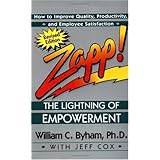
Zapp The Lightning of Empowerment: How to Improve Productivity, Quality, and Employee Satisfaction Review

Zapp The Lightning of Empowerment: How to Improve Productivity, Quality, and Employee Satisfaction
Average Reviews:

(More customer reviews)
Many people fail to focus on whether or not their message is received. More effective people focus on whether the message is received as they attempt to improve communications so their company can be more successful. ZAPP! also focuses on WHAT message is received. As the book shows, a perceived message can be dispiriting or empowering.
I liked the fact that the book spent as much time on explaining about bad communications as it did on good ones. That is a great way to help people improve.
The only thing I did not like about the book was that the end led into a sales pitch for consulting rather than tips for how to pursue this on your own. It seemed out of keeping in a book about empowerment. Skip the last 2 pages, and you will be left with a better taste in your mouth.
Buy, read, think about, apply, and share this book and the lessons above with your colleagues. That will help you get heart-warming results to go with the heart-warming feeling that reading this book provides. Enjoy!

Click Here to see more reviews about: Zapp The Lightning of Empowerment: How to Improve Productivity, Quality, and Employee Satisfaction

Most managers know that revitalization in their companies must occur from the ground up. But how to get that message to employees without applying the kind of pressure that makes them even less productive? The answer is empowerment. In this motivating book, you will find specific strategies designed to help you encourage responsibility, acknowledgment, and creativity so that employees feel they "own" their jobs. It's all here, in an accessible guide for the successful managers of tomorrow.

Buy Now

Click here for more information about Zapp The Lightning of Empowerment: How to Improve Productivity, Quality, and Employee Satisfaction

Read More...

Strengths-Based Leadership Review

Strengths-Based Leadership
Average Reviews:

(More customer reviews)
Rath and Conchie have provided us with a helpful tool for fine-tuning our own leadership capacity. Using statistical factor analysis of data in Gallup's database, the authors detail how balanced leadership teams have strengths within four Leadership Domains: Strategic Thinking, Relationship Building, Influencing, and Executing. The authors relate that while individuals are rarely balanced, teams always should be. Leadership Teams operating in these four domains work both to serve the four primary needs of their constituencies and to execute their primary organizational responsibilities.
Using a recent Gallup review of data from 10,000 followers, the authors also report that followers report surprising agreement on four of their primary needs: trust, compassion, stability, and hope.
Leaders who use the code that comes with the book to take the online Strengthsfinder assessment (www.strengthsfinder.com) to determine their Top 5 Strengths are provided with a customized Strengths-Based Leadership report that help them understand their Top 5 Strengths and a Strengths-Based Leadership Guide that provides detailed advice on how to use each of their Top 5 Strengths to meet the four primary needs.
Leaders who read this book will have a deepened appreciation of both their own leadership abilities and of the degree to which they lead best when they work in team. The four Leadership Domains and the four primary needs of followers provide leaders with a rich paradigm for considering new approaches in attacking organizational priorities.
Highly recommended.

Click Here to see more reviews about: Strengths-Based Leadership

For decades, Gallup scientists have researched the topic of leadership. They've surveyed a million work teams, conducted more than 50,000 in-depth interviews with leaders, and even interviewed 20,000 followers to ask what they admired in the most important leader in their life. The results of that research are unveiled in Strengths-Based Leadership. Using Gallup's discoveries, authors Tom Rath and Barry Conchie identify three keys to being an effective leader and use firsthand accounts from highly successful leaders - including the founder of Teach for America and the president of The Ritz-Carlton - to show how each person's unique talents can drive their success. A new version of Gallup's popular StrengthsFinder assessment helps readers discover their own special gifts, and specific strategies show them how to lead with their top five talents. Loaded with novel research, inspiring stories, and actionable ideas, Strengths-Based Leadership offers a new roadmap for leading people toward a better future.

Buy Now

Click here for more information about Strengths-Based Leadership

Read More...

Conversation and Community: The Social Web for Documentation Review

Conversation and Community: The Social Web for Documentation
Average Reviews:

(More customer reviews)
Anne is a technical writer who has done a considerable amount of work with FLOSS Manuals in documenting the OLPC laptop, and is obviously well-versed in both open-source documentation and social media. The book is designed to give technical writers and other information developers an overview of the tools and techniques available now for documenting products and communicating with end-users through social media and other non-traditional methods.
As a technical writer and community manager, I am exactly the target market for this book, so it is no wonder that I think it is an excellent resource that is long overdue. What surprised me was the depth with which she covered her subjects, the extensive yet highly selective quality of references in the book, and the sheer number of strategies that I hadn't yet encountered even as a professional in this area.
The most important point Anne makes in the book is that documentation as we know it is changing dramatically. Practically all of the basic tenets of technical documentation are in question. Users depend far more often on advice from random strangers via mailing lists, community forums, and search engines than they do on the technical documentation that comes with the product. I have seen this to be true even for highly technical concepts and tools. This is not news to anyone who has ever used Google to find the answer to a technical question rather than looking in the docs, but it was fascinating to see that phenomenon addressed in such a way that my opinions of it were actually changed. Like many technical writers, I have a lingering fear that I will someday be obsolete and that my job of communicating technical issues to users of technology will be taken over by amateurs in ad-hoc communities. Anne gently reminds us that it is the quantity of information that is skyrocketing, not the quality, and that our jobs as technical communicators are more important than ever in making that information "findable", even if that means abandoning what we traditionally think of as documentation. What I took away from this aspect of the book was the overwhelming necessity to make human connections, even in technical documentation, an idea that resonates strongly with my own role as a community builder. Chapter 3 spells it out best as "Defining a Writer's Role with the Social Web".
The book catalogs the available tools and strategies from several different viewpoints based on documentation strategy---in other words, use cases---rather than simply providing an annotated list. Anne specifically points to references and in-the-trenches stories that underscore her points in a very effective way. The subject that brought me the most "aha!" moments was that of wikis. I use wikis on a daily basis, but there were certain aspects of them that I had overlooked. There were so many interesting references in all sections that I felt compelled to stop reading the book and follow them, which is not a criticism of the writing but rather of the sheer amount of information out there. The consistent, confident, professional tone kept me riveted to the book, but I am now going back over every page and following links.
I highly recommend this book to both technical communicators and those involved in social media and community. My copy is going straight to my boss' desk.

Click Here to see more reviews about: Conversation and Community: The Social Web for Documentation

Conversation and Community: The Social Web for Technical Documentation, industry expert Anne Gentle's new book, brings the tools of the Social Web to technical documentation. She looks at the most important Web 2.0 tools, including blogs, wikis, micro-blogging, and syndication, and shows how they can be used to foster conversations and a community with your customers.Through examples and her own hard-won experience with these technologies, Gentle provides practical guidance for technical communicators, marketers, and anyone who wants to use the Social Web to interact with customers.

Buy Now

Click here for more information about Conversation and Community: The Social Web for Documentation

Read More...