Showing posts with label conservatism. Show all posts

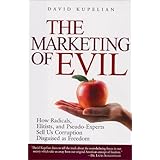
The Marketing of Evil: How Radicals, Elitists, and Pseudo-Experts Sell Us Corruption Disguised As Freedom Review

The Marketing of Evil: How Radicals, Elitists, and Pseudo-Experts Sell Us Corruption Disguised As Freedom
Average Reviews:

(More customer reviews)
When I heard about the OSU college professor feeling unsafe and personally threatened by the prospect of someone reading The Marketing of Evil, curiosity got the better of me. Judging by the reviews here, the book obviously has some learned, thoughtful, and articulate readership. I was moved enough myself by the book to try and add my two cents worth.
First, I'm very impressed with how well written and edited the book is. Most non-fiction that is any good might make a worthwhile point every few pages. With this book, it's more like every couple of sentences. It's short and easy reading, but fully packed. And not one of the topics raised is a puff piece. Each is big, really big, and poignant to today's society. The author discusses ten issues, one per chapter, and I expect any one of them dropped among a random group of people could start a heated argument in about 15 seconds. You can't do a "search inside the book" so here's the 10 topics/chapters:
Gay rights
Myth of church-state separation
Selling of sex
The 60's generation
Destruction of marriage
Sexual revolution based on fraudulent science
Hijacking of American school system
World of illusion created by press
Selling of unrestricted abortion
Role of Christianity in America
Like I said, heavy-duty stuff. And the author addresses each topic head-on without sarcasm, hyperbole, or sensationalism. He is also very consistent to his theme, i.e., how the radical elements within our society have successfully, and with intent, marketed their particular view to the rest of us. To those that doubt the author's premise, all I can say is I was in college in the 60s and the evidence presented seems right on target to me. And if you don't believe it, then read the admissions of the very people doing the marketing in question. Do some fact checking. Read some of the source material. It is eye popping, depressing, and maybe even scary.
The book is not up lifting, nor intended to be. Reading it is like turning on a bright light in a smelly flophouse. We had a good idea the roaches were in there, but we'd rather let someone else deal with it. (Unfortunately, there's no one else living here but us).
It seems the book's first chapter, gay rights, gets most of the attention from detractors. None of the other chapters are any less weighty or volatile. It's not a book about the evil of gay rights, it's a book about successful marketing. There is much irony here for both the left and the right. The radical left, the avowed enemies of Wal-Mart, capitalism, Christianity, traditional morality, etc. make use of the very tools of the society they condemn, and very much to their personal profit. Meanwhile, those on the right have allowed themselves to be sucked into the moral abyss by the very same tools they hold in such high regard. Nothing to be proud of. It's terribly sobering and thought provoking. That the book might be recommended reading for an incoming freshmen class is the height of sanity to me, definitely not something to be condemned and investigated.
I also find interesting how unenthusiastic and ineffective the negative reviewers are for this book. When Al Franken or Ann Coulter write a book, we can count on the negative reviewers getting in some good shots and collecting a reasonable momentum of fellow reviewers. Not so with The Marketing of Evil. Why not? A couple of reasons, I think. First, the author treats each subject and his readers with deep respect. There is no attempt at humor or provocation. He just presents his evidence in a professional and effective manner. Second, the evidence results in a pretty much iron clad case. Detractors just come off looking petty and infantile. The best recourse for those on the left is to not draw attention to this book.
I have a better understanding why the college prof acted the way he did. The act of people reading this book could very well be a threat to your worldview because there is almost no defense against the enlightenment contained. The radical left worldview is built on such an illogical house of cards, the prospect of removing just one (let alone 10!) could indeed be terrifying. All you can do is scurry under the refrigerator or flip on your back and waggle your arms and legs in a fit of mortal hysteria.
Finally, no matter what the subject, I really appreciate books that are well written, succinct, and cut through the fog of muddled, conventional dogma with sincerity and honesty. There are so few! (In the last year I've only come across two ... this one, and Hunicutt's Joe X). Yes, The Marketing of Evil may be a bit of a downer (though the last chapter is a good counter balance), but it's also highly clarifying. It's an outstanding book, and an important one to read.

Click Here to see more reviews about: The Marketing of Evil: How Radicals, Elitists, and Pseudo-Experts Sell Us Corruption Disguised As Freedom

Americans have come to tolerate, embrace and even champion many things that would have horrified their parents' generation-from easy divorce and unrestricted abortion-on-demand to extreme body piercing and teaching homosexuality to grade-schoolers. Does that mean today's Americans are inherently more morally confused and depraved than previous generations? Of course not, says veteran journalist David Kupelian. But they have fallen victim to some of the most stunningly brilliant and compelling marketing campaigns in modern history.

The Marketing of Evil reveals how much of what Americans once almost universally abhorred has been packaged, perfumed, gift-wrapped and sold to them as though it had great value. Highly skilled marketers, playing on our deeply felt national values of fairness, generosity and tolerance, have persuaded us to embrace as enlightened and noble that which all previous generations since America's founding regarded as grossly self-destructive-in a word, evil.

Buy Now

Click here for more information about The Marketing of Evil: How Radicals, Elitists, and Pseudo-Experts Sell Us Corruption Disguised As Freedom

Read More...

Unprotected Review

Unprotected
Average Reviews:

(More customer reviews)
The author of this book is a psychiatrist at a university health clinic. She has written the book anonymously because she is still working and what she has to say is politically unacceptable to the current mental health establishment. If she stated this openly she would risk her career. However, I am very glad this book has been printed and hope that the author can come out openly and speak on this important topic.
We are taken into the way a student clinic at a typical university runs and how their policies work against the values of students with religious faith and beliefs that run contrary to the politically correct environment of today's colleges and the mental health profession generally. The author shows us how the profession of psychology has become the promoter and enforcer of a certain belief system around sexuality that is antithetical to most mainstream religious faith. She even quotes one past president of the main professional organization saying that his profession needs to help rid people of their religious faith.
The basic idea of the book is that we teach young people to be very particular in what they eat, how they exercise, to be ridiculously frightened of the dangers of second hand smoke, and to flee in terror if a teaspoonful of elemental mercury is spilled in a classroom, yet we are not honest with them about the dangers of casual sexual practices and that safer sex is no such thing. We don't teach young women that sex is biologically, hormonally, and emotionally different for them than it is for men and they are more likely to end up with depression and anxiety issues than the men they have casual relationships with.
We don't teach them that even with condom use they are vulnerable to many kinds of STDs that are still easily transferred. That there are millions of new cases of STDs that can have a permanent effect on a woman's fertility because of the way they set up the woman's immune system to fight the disease it will also fight a newly conceived baby.
And we are not honest with them when we say that AIDS is an equal opportunity disease. HIV infection has more to do with the kinds of sexual practices engaged in and the use of IV drugs than anything else. We do not tell them that young people who postpone sex until marriage and are monogamous and avoid IV drugs or partners who use them that they will be most unlikely to become infected with HIV.
She also takes apart the ridiculous notion that abortion never causes a woman emotional difficulties afterwards. We are shown how something on the order of 20% of women have something akin to post traumatic stress syndrome from these abortions. That is 1 in 5. Can you imagine any other health issues that had such a high incidence that would be denied as occurring or admitted to as happening only very rarely? Given the ridiculous attention paid to second hand smoke (the notion that if you can smell a cigarette within 100 feet of you your health is being damaged) it cannot be that something with actual mental health implications could be missed in an honest and serious way. No, it is suppressed because of the politics of sexuality.
There is a lot of great information and illustrative anecdotes that make her points well. I particularly like these paragraphs in her concluding chapter:
"To our colleagues and Universities: Stop the normalization of behaviors that many therapists - not to mention parents of your students - consider depraved. Again, that this even needs to be said is indicative of the sad state we are in."
"Admit the trauma, to some women and some men, of abortion. Reach out to those for whom the experience has not been an opportunity for `growth and maturation'. Provide a support group; at the very least ask about it!"
"The exaggerated place of sexuality is grotesque and destructive. We are not defined by our urges - straight, gay, lesbian, or bi. What sort of message is that to our youth? We are defined by something more essential, uplifting, and transcendent. I fear this ideology that enshrines the body (health, appearance, physical please) and abandons the soul (meaning, self-sacrifice, family, church)."
"Recognize that for many students, faith may be a tool to promote mental health. In sorting out the dilemma of suicides on campus, consider if perhaps the soullessness and angst among secularism contributes. When patients struggle with suicide, discussion of ultimate issues like meaning, purpose and God are imperative. Acknowledge the benefits of self-restraint in areas other than diet, tobacco, and alcohol. Self-discipline exists outside the cafeteria and the gym."
Recommended strongly.

Click Here to see more reviews about: Unprotected

Our campuses are steeped in political correctness—that's hardly news to anyone. But no one realizes that radical social agendas have also taken over campus health and counseling centers, with dire consequences. Psychiatrist Miriam Grossman knows this better than anyone. She has treated more than 2,000 students at one of America's most prestigious universities, and she's seen how the anything- goes, women-are-just-like-men, "safer-sex" agenda is actually making our sons and daughters sick. Dr. Grossman takes issue with the experts who suggest that students problems can be solved with free condoms and Zoloft. What campus counselors and health providers must do, she argues, is tell uncomfortable, politically incorrect truths, especially to young patients in their most vulnerable and confused moments. Instead of platitudes and misinformation, it's time to offer them real protection.

Buy Now

Click here for more information about Unprotected

Read More...

Money Mischief: Episodes in Monetary History Review

Money Mischief: Episodes in Monetary History
Average Reviews:

(More customer reviews)
In his best selling study, Robert L. Heilbroner calls Economists 'The worldly philosophers'. That description certainly captures what Milton Friedman does in this book - he takes the seemingly simple concept of money, the unit of exchange we use daily and rarely reflect upon, and demonstrates how complicated the issues regarding it are.

(As an interesting aside, Heilbroner's original title for his book was 'the money philosophers' - a definition that fits Friedman in this book even better then his chosen title, even if it is too narrow to account for all of economics).
More then half of this collection of essays is about the so-called 'Crime of 1873' - America's decision, following the issuance of fiat money (that is, money irredeemable in specie) during the Civil War, to peg the dollar not to both silver and gold, but to gold alone. This seemingly arcane and academic topic was a major political issue in the 1880s and 90s, climaxing with the nomination of the silver Democrat, William Jennings Bryan to the presidency of the United States in 1896.
As the Unites States, along with most other 19th century nations such as Germany and France, followed Great Britain in adopting the gold standard, the price of gold rose in terms of other resources, so prices went down. Therefore there was a severe deflation causing much unrest and discontent.
The cure to the deflation came not through political or monetary means, however, but because of an invention of a method to extract gold from low grade ore. This increased the supply of gold, lowered its prices. Hence stopping the deflation, and killing the presidential ambitions of William Jennings Bryan.
The rest of the book describes various issues, from FDR's decision to 'help silver' which helped Communism in China instead (by increasing the cost of silver, overvaluing the Chinese currency and thus hurting Chinese exports and undermining the Chinese economy), to the policy of pegging a currency to the dollar (not a good idea as it subjects the country to the whims of the world economy. The policy was a grave failure to Chile and a great success to Israel, due entirely to external changes in the value of the dollar).
The theme of the later parts of the book is undoubtedly inflation. Friedman demonstrates his claim that inflation is "always and everywhere a monetary phenomenon" (p.104). Inflation is caused by government increasing the money supply, although one time price increases may be caused by unfortunate outside events (like Arabs reduction of the exportation of oil in the early 1979s).
Although Friedman is well known as an economic right winger, there is nothing in this account that should be displeasing to anyone from the left - Friedman's case is against mismanagement, not for small or big governments. Nor is there any argument about whether government spending should go to the military, to welfare, or to any other cause. Although Friedman's book is filled with stories of the political economy, its moral is politically neutral. Indeed, Friedman clearly discusses how inflation is often used by governments because direct taxation is unpopular (p.205) - can you say "read my lips, no new taxes"?
Furthermore, the economic analysis of some reviewers in Amazon is shaky. Friedman writes "all these adjustments [the negative effects of inflation] are set in motion by changes in the rates of monetary growth and inflation. If monetary growth was high but steady... the economy would adjust to it. ... Such an inflation would do no great harm " (p.222).
Although Friedman does not like inflation, he actually makes a case for it, at least at a low single digit level. Since people are usually sellers of few things and purchasers of many, they are more aware of the increase in the price of the commodity they sell then they are of the increase of general prices, especially when those changes are low. People like to see their income go up, as they feel it is a just reward for their efforts (p. 70).
'Money Mischief' is an interesting, challenging book. Its chapters vary from the extremely technical and difficult, (notably chapter 4, a counter-factual exercise estimating the effect of continuing bimetallism after 1873), to 'pop economics' chapters which are no less enlightening and easier to read.
The book ends with a discussion of the new experiment started in the 1970s - currency which is entirely unredeemable by any kind of good. Earlier economists thought that this was impossible, and would necessarily lead to high inflation, but Friedman is optimistic - he believes that aware and well informed public and decision makers can pressure the government against unduly increasing the money supply. Thus, widespread understanding of economics is the real cure for inflation.

Click Here to see more reviews about: Money Mischief: Episodes in Monetary History


Buy Now

Click here for more information about Money Mischief: Episodes in Monetary History

Read More...