Showing posts with label gold. Show all posts

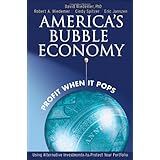
America's Bubble Economy: Profit When It Pops Review

America's Bubble Economy: Profit When It Pops
Average Reviews:

(More customer reviews)
You can give this book a pass. There's really nothing to it, so save your money. While one might agree wholeheartedly with its premise and conclusions, the exposition here is not the best. For comparison, take a look at Stephen Leeb's Chapter 5 in his "Oil Factor" of 2004 and you will see a much cleaner more informative discussion of just about everything in the "Bubble" book. Leeb is far more succinct and authoritative and manages to avoid what is becoming the most overused word in the language -- "bubble." And he does it in 11 pages.
The investment advice in this book, once you get past all the padding, is to buy gold and euros. The advice on gold at least comes with a cursory analysis of the supply and demand situation, but the advice on the euro is given without support. There's no discussion whatsoever of the economic realities facing the European Union and how they might impact the dollar/euro exchange rates. I'm not saying there isn't a good reason to run to euros, just that it appears nowhere in this book.
One of the other reviewers was as annoyed as I was about the poor editing in this book. In addition to misspelling Warren Buffett's name numerous times, including in the index, there is a general carelessness that made reading each chapter a hunt for mistakes. I expect more from Wiley.
If this is your first exposure to discussion of the multiple problems facing our economy from housing prices, government debt, consumer debt, and foreign exchange risks, it may serve as a readable introduction. However, don't expect too much depth and be prepared for typos and misspellings. A two star rating is pretty generous.

Click Here to see more reviews about: America's Bubble Economy: Profit When It Pops


Buy Now

Click here for more information about America's Bubble Economy: Profit When It Pops

Read More...

Money Mischief: Episodes in Monetary History Review

Money Mischief: Episodes in Monetary History
Average Reviews:

(More customer reviews)
In his best selling study, Robert L. Heilbroner calls Economists 'The worldly philosophers'. That description certainly captures what Milton Friedman does in this book - he takes the seemingly simple concept of money, the unit of exchange we use daily and rarely reflect upon, and demonstrates how complicated the issues regarding it are.

(As an interesting aside, Heilbroner's original title for his book was 'the money philosophers' - a definition that fits Friedman in this book even better then his chosen title, even if it is too narrow to account for all of economics).
More then half of this collection of essays is about the so-called 'Crime of 1873' - America's decision, following the issuance of fiat money (that is, money irredeemable in specie) during the Civil War, to peg the dollar not to both silver and gold, but to gold alone. This seemingly arcane and academic topic was a major political issue in the 1880s and 90s, climaxing with the nomination of the silver Democrat, William Jennings Bryan to the presidency of the United States in 1896.
As the Unites States, along with most other 19th century nations such as Germany and France, followed Great Britain in adopting the gold standard, the price of gold rose in terms of other resources, so prices went down. Therefore there was a severe deflation causing much unrest and discontent.
The cure to the deflation came not through political or monetary means, however, but because of an invention of a method to extract gold from low grade ore. This increased the supply of gold, lowered its prices. Hence stopping the deflation, and killing the presidential ambitions of William Jennings Bryan.
The rest of the book describes various issues, from FDR's decision to 'help silver' which helped Communism in China instead (by increasing the cost of silver, overvaluing the Chinese currency and thus hurting Chinese exports and undermining the Chinese economy), to the policy of pegging a currency to the dollar (not a good idea as it subjects the country to the whims of the world economy. The policy was a grave failure to Chile and a great success to Israel, due entirely to external changes in the value of the dollar).
The theme of the later parts of the book is undoubtedly inflation. Friedman demonstrates his claim that inflation is "always and everywhere a monetary phenomenon" (p.104). Inflation is caused by government increasing the money supply, although one time price increases may be caused by unfortunate outside events (like Arabs reduction of the exportation of oil in the early 1979s).
Although Friedman is well known as an economic right winger, there is nothing in this account that should be displeasing to anyone from the left - Friedman's case is against mismanagement, not for small or big governments. Nor is there any argument about whether government spending should go to the military, to welfare, or to any other cause. Although Friedman's book is filled with stories of the political economy, its moral is politically neutral. Indeed, Friedman clearly discusses how inflation is often used by governments because direct taxation is unpopular (p.205) - can you say "read my lips, no new taxes"?
Furthermore, the economic analysis of some reviewers in Amazon is shaky. Friedman writes "all these adjustments [the negative effects of inflation] are set in motion by changes in the rates of monetary growth and inflation. If monetary growth was high but steady... the economy would adjust to it. ... Such an inflation would do no great harm " (p.222).
Although Friedman does not like inflation, he actually makes a case for it, at least at a low single digit level. Since people are usually sellers of few things and purchasers of many, they are more aware of the increase in the price of the commodity they sell then they are of the increase of general prices, especially when those changes are low. People like to see their income go up, as they feel it is a just reward for their efforts (p. 70).
'Money Mischief' is an interesting, challenging book. Its chapters vary from the extremely technical and difficult, (notably chapter 4, a counter-factual exercise estimating the effect of continuing bimetallism after 1873), to 'pop economics' chapters which are no less enlightening and easier to read.
The book ends with a discussion of the new experiment started in the 1970s - currency which is entirely unredeemable by any kind of good. Earlier economists thought that this was impossible, and would necessarily lead to high inflation, but Friedman is optimistic - he believes that aware and well informed public and decision makers can pressure the government against unduly increasing the money supply. Thus, widespread understanding of economics is the real cure for inflation.

Click Here to see more reviews about: Money Mischief: Episodes in Monetary History


Buy Now

Click here for more information about Money Mischief: Episodes in Monetary History

Read More...

Rich Dad's Advisors: Guide to Investing In Gold and Silver: Protect Your Financial Future Review

Rich Dad's Advisors: Guide to Investing In Gold and Silver: Protect Your Financial Future
Average Reviews:

(More customer reviews)
Mike has made a compelling case that sooner, rather than later, the US Dollar is going to tank and everyone will be running to gold and silver to protect their wealth. The good news is that NOW is the time to get in on both silver and gold- before the HERD of people start rushing in. Mike states that this opportunity coming could be the best investment in history.
The book starts off with the history of other empires that have used a fiat currency and how they have failed 100% of the time. The United States has been on this path since Aug, 1971 when President Nixon took us off the gold standard. There are a lot of interesting facts in this book but not too many to bore the reader. He explains that gold and silver will revalue themselves periodically in relation to the amount of paper currency printed. For example, the M3 money supply (total printed money in circulation) was ~$1.7 billion in January, 1980 when gold hit $850 an ounce. Today, the M3 is estimated at $14 trillion, a 7.7 times increase in the amount of currency. With that said, gold, when it adjusts, should be $6,118.00 an ounce...
Mike goes into today's current economic climate, then predictions for "tomorrow". He concludes with the final section "How to Invest in Precious Metals".
I recommend this book if you are unsure about silver and gold relating to investing. There's so much documentation and research behind it.
I've never read an investment book with this much passion put into it!!!

Click Here to see more reviews about: Rich Dad's Advisors: Guide to Investing In Gold and Silver: Protect Your Financial Future

"Throughout the ages, many things have been used as currency: livestock, grains, spices, shells, beads, and now paper.But only two things have ever been money: gold and silver.When paper money becomes too abundant, and thus loses its value, man always turns back to precious metals.During these times there is always an enormous wealth transfer, and it is within your power to transfer that wealth away from you or toward you."--Michael Maloney, precious metals investment expert and historian; founder and principal, Gold & Silver, Inc. The Advanced Guide to Investing Gold and Silver tells readers: The essential history of economic cycles that make gold and silver the ultimate monetary standard. How the U.S. government is driving inflation by diluting our money supply and weakening our purchasing power Why precious metals are one of the most profitable, easiest, and safest investments you can make Where, when, and how to invest your money and realize maximum returns, no matter what the economy's state Essential advice on avoiding the middleman and taking control of your financial destiny by making your investments directly.

Buy Now

Click here for more information about Rich Dad's Advisors: Guide to Investing In Gold and Silver: Protect Your Financial Future

Read More...