Showing posts with label america. Show all posts

What We Say Goes: Conversations on U.S. Power in a Changing World Review

What We Say Goes: Conversations on U.S. Power in a Changing World
Average Reviews:

(More customer reviews)
Edit of 15 Jun 09 to correct factual error in original review (nuclear deal with Iran under Gerald Ford, not Ronald Reagan, in 1974).
Chomsky is actually starting to win over the balanced middle with his common sense. I have long respected him, but it took Dick Cheney and his merry band of nakedly amoral and obliviously delusional henchmen to really bring home to America how much his straight talk and logical thinking can help us.
There is virtually no repetition from past works. This series of interviews took place in 2006 and early 2007, and I found a great deal here worth noting.
*In 70 New York Times editorials on Iraq, not once did they mention international law or the United Nations Charter. He uses this and several other examples to show how pallid, how myopic, how unprofessional our mainstream media has become.
*A wonderful section talks about how civil *obedience* of immoral and illegal orders is our biggest challenge in this era, and I agree. The "failure of generalship" in the Pentagon resulted from a well-meaning but profoundly misdirected confusion of loyalty to the civilian chain of command, however lunatic, with the integrity that each of our senior swore to the Constitution and to We the People in their Oath of Office.
*His knowledge of Lebanon, a country I have come to love as representative of all that is good in the Middle East, is most helpful. His many remarks, all documented, make it clear that Israel has been abducting people for decades, and that the Lebanese have quite properly come to equate US "freedom" with the "kiss of death." I am especially impressed with his discussion of Hezbollah as having legitimacy based on providing social services to those ignored by past governments, and as having a significant strategic value to Iran as a flank on Israel. His observations on how the US consistently refuses to recognize honest elections that do not go as the policymakers (not the US public) wish, are valid.
*He reminds us that the US made an enormous strategic mistake in using Saudi Arabian extremist Islam as a counterpoint to Nasser's natural Arab nationalism. As Robert Baer puts it, we see no evil and slept with the devil like a common whore lusting for oil.
*His comments on China and the Shi'ites who sit on most of the reserves (including Saudi reserves in one corner of that country, are provocative. I am rapidly coming to the conclusion that the USA needs to cede the oil to China and execute a Manhattan Project to leverage solar power from space, tidal power, air power, and--for storage--hydrogen power made with renewable resources.
*Chomsky's comments on Chavez track with my own understanding. Chavez is a serious and well-off revolutionary who is sharing energy with his Latin American brethren, and leading the independence of Latin America from the overbearing and often hypocritical and predatory US government and US multinational corporations.
*He offers compelling thoughts on how India is sacrificing hundreds of thousands of poor rural people who now commit suicide or migrate to cities after losing their lands, for the sake of the high technology investments. I wonder why India is not doing more to teach the poor "one cell call at a time."
*His observations on US electoral fraud are brilliant. He points out that the fact that elections are stolen is much less important than the fact that the entire electoral process in the US is fraudulent, without substance, only posturing and platitudes.
*He discusses how the US public is completely divorced from the policy choices of the dual tyranny of the US (political) government and the US corporate sector.
*At every turn Chomsky offers common sense observations, for instance, Pakistan, not Iran, is vastly more likely to leak nuclear capabilities to jihadists. In passing, he points out that it was the US that gave the Shah of Iran an entire MIT nuclear program and substantive assistance that is now being harvested by Iran, in 1975. Kissinger, Cheney,Rumsfeld, and Wolfowitz as well as Gerald Ford are mentioned by name.
*He observes that Israeli influence is vastly larger than the lobbying effort, because the entire US intellectual network has "bought into" the Israeli myths and lies. The American fascists (see American Fascists: The Christian Right and the War On America), the Christian fundamentalists, are actually anti-Semitic, but support Israel because of their belief in the apocalypse.
*The Internet is having a pernicious effect on dialog and debate and compromise, because it creates little cul-de-sacs for lunatics of like mind to find and reinforce one another, divorced from larger realities.
*Avian flu (and our lack of preparation for it) is vastly more dangerous than a nuclear event. (See my review of the DVD Pandemic).
*Missile "defense" is actually code for allowing a first strike by the US on Russia or China, as a means to moderating their counter-strike. This is the first time I have heard it put this way, and I agree. All Americans should oppose "missile defense."
*State secrecy is about keeping our own citizens ignorant of the crimes being done "in our name" not about keeping secrets from the enemies we a re covertly screwing over time and again.
*Darfur is being dumbed down, at the same time that the *millions* being genocided in the Congo are being ignored.
*He ends on two good notes. Like Thomas Jefferson (A Nation's best defense is an educated citizenry") he says that "educating the American people is the main thing to be done," and love of the people is fundamental.
Great book, completely fresh and absolutely worth reading for the mainstream that might have in the past written Chomsky off as a perennial leftist, which he is not. Chomsky is what we must all seek to be: an educated engaged citizen.
See also:
Vice: Dick Cheney and the Hijacking of the American Presidency
The One Percent Doctrine: Deep Inside America's Pursuit of Its Enemies Since 9/11
Crossing the Rubicon: The Decline of the American Empire at the End of the Age of Oil
The Sorrows of Empire: Militarism, Secrecy, and the End of the Republic (The American Empire Project)
Rogue Nation: American Unilateralism and the Failure of Good Intentions
State of Denial: Bush at War, Part III
Bush's Brain
Why We Fight


Click Here to see more reviews about: What We Say Goes: Conversations on U.S. Power in a Changing World

An indispensable set of interviews on foreign and domestic issues with the bestselling author of Hegemony or Survival, "America's most useful citizen." (The Boston Globe)

Buy Now

Click here for more information about What We Say Goes: Conversations on U.S. Power in a Changing World

Read More...

The Girl in the Tangerine Scarf: A Novel Review

The Girl in the Tangerine Scarf: A Novel
Average Reviews:

(More customer reviews)
A book that yields rich insights on several dimensions. The dominant one is what it is like to grow up as a minority within the American culture - and not just any old minority, but as a Muslim, which parts of American society are actively trying to demonize. It was the "flip-side" of my own experience, living as a non-Muslim in the very heartland of Islam, Saudi Arabia, for a quarter century. While I was never forced to deal with issues of assimilation, Ms. Kahf's character, Khadra, must wrestle with the parts of her heritage that are essential, and those that can be jettisoned. How many religious injunctions are merely codified fetishes, illustrated by the refusal to eat any meat from the deli because of the meat-cutter?
There are numerous important sub-themes. The timeless subject of male-female relations, with that "Islamic twist" is shown in a realistic light, covering a spectrum of possibilities. Through her characters, Blu and Bitsy, who were Khadra's roommates at various periods, Ms. Kafh is able to illustrate nuances in beliefs that are all too often generalized. Blu is Jewish, and there is much agreement between these "daughters of Abraham," except on that haram subject of Israel and Palestine. Bitsy is Iranian, and leaves notes around the apartment blaming "the Arabs" for all of Iran's problems.
Khadra's trip to Saudi Arabia, to complete the Haj, was more uneven. There is no question that cocaine exists in the Kingdom, but I found the particular scene in which it was depicted playing heavily towards that stereotypical view of rich, decadent Saudis. More realistic, and more insightful are her dealings with the mutawaa (the religious police), and in particular how various Saudi males refuse to confront their arrogance and inappropriate behavior.
Ms. Kafh is clearly erudite, in a most important trans-cultural way. Her epigraphs ground her novel in the wider world of ideas, and these selections range from Rumi and Al-Arabi to James Baldwin and Leonard Cohen.
A strong book, which addresses some of the central issues of our times.... And is strongly recommended.


Click Here to see more reviews about: The Girl in the Tangerine Scarf: A Novel


Buy Now

Click here for more information about The Girl in the Tangerine Scarf: A Novel

Read More...

The Marketing of Evil: How Radicals, Elitists, and Pseudo-Experts Sell Us Corruption Disguised As Freedom Review

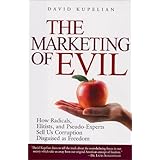
The Marketing of Evil: How Radicals, Elitists, and Pseudo-Experts Sell Us Corruption Disguised As Freedom
Average Reviews:

(More customer reviews)
When I heard about the OSU college professor feeling unsafe and personally threatened by the prospect of someone reading The Marketing of Evil, curiosity got the better of me. Judging by the reviews here, the book obviously has some learned, thoughtful, and articulate readership. I was moved enough myself by the book to try and add my two cents worth.
First, I'm very impressed with how well written and edited the book is. Most non-fiction that is any good might make a worthwhile point every few pages. With this book, it's more like every couple of sentences. It's short and easy reading, but fully packed. And not one of the topics raised is a puff piece. Each is big, really big, and poignant to today's society. The author discusses ten issues, one per chapter, and I expect any one of them dropped among a random group of people could start a heated argument in about 15 seconds. You can't do a "search inside the book" so here's the 10 topics/chapters:
Gay rights
Myth of church-state separation
Selling of sex
The 60's generation
Destruction of marriage
Sexual revolution based on fraudulent science
Hijacking of American school system
World of illusion created by press
Selling of unrestricted abortion
Role of Christianity in America
Like I said, heavy-duty stuff. And the author addresses each topic head-on without sarcasm, hyperbole, or sensationalism. He is also very consistent to his theme, i.e., how the radical elements within our society have successfully, and with intent, marketed their particular view to the rest of us. To those that doubt the author's premise, all I can say is I was in college in the 60s and the evidence presented seems right on target to me. And if you don't believe it, then read the admissions of the very people doing the marketing in question. Do some fact checking. Read some of the source material. It is eye popping, depressing, and maybe even scary.
The book is not up lifting, nor intended to be. Reading it is like turning on a bright light in a smelly flophouse. We had a good idea the roaches were in there, but we'd rather let someone else deal with it. (Unfortunately, there's no one else living here but us).
It seems the book's first chapter, gay rights, gets most of the attention from detractors. None of the other chapters are any less weighty or volatile. It's not a book about the evil of gay rights, it's a book about successful marketing. There is much irony here for both the left and the right. The radical left, the avowed enemies of Wal-Mart, capitalism, Christianity, traditional morality, etc. make use of the very tools of the society they condemn, and very much to their personal profit. Meanwhile, those on the right have allowed themselves to be sucked into the moral abyss by the very same tools they hold in such high regard. Nothing to be proud of. It's terribly sobering and thought provoking. That the book might be recommended reading for an incoming freshmen class is the height of sanity to me, definitely not something to be condemned and investigated.
I also find interesting how unenthusiastic and ineffective the negative reviewers are for this book. When Al Franken or Ann Coulter write a book, we can count on the negative reviewers getting in some good shots and collecting a reasonable momentum of fellow reviewers. Not so with The Marketing of Evil. Why not? A couple of reasons, I think. First, the author treats each subject and his readers with deep respect. There is no attempt at humor or provocation. He just presents his evidence in a professional and effective manner. Second, the evidence results in a pretty much iron clad case. Detractors just come off looking petty and infantile. The best recourse for those on the left is to not draw attention to this book.
I have a better understanding why the college prof acted the way he did. The act of people reading this book could very well be a threat to your worldview because there is almost no defense against the enlightenment contained. The radical left worldview is built on such an illogical house of cards, the prospect of removing just one (let alone 10!) could indeed be terrifying. All you can do is scurry under the refrigerator or flip on your back and waggle your arms and legs in a fit of mortal hysteria.
Finally, no matter what the subject, I really appreciate books that are well written, succinct, and cut through the fog of muddled, conventional dogma with sincerity and honesty. There are so few! (In the last year I've only come across two ... this one, and Hunicutt's Joe X). Yes, The Marketing of Evil may be a bit of a downer (though the last chapter is a good counter balance), but it's also highly clarifying. It's an outstanding book, and an important one to read.

Click Here to see more reviews about: The Marketing of Evil: How Radicals, Elitists, and Pseudo-Experts Sell Us Corruption Disguised As Freedom

Americans have come to tolerate, embrace and even champion many things that would have horrified their parents' generation-from easy divorce and unrestricted abortion-on-demand to extreme body piercing and teaching homosexuality to grade-schoolers. Does that mean today's Americans are inherently more morally confused and depraved than previous generations? Of course not, says veteran journalist David Kupelian. But they have fallen victim to some of the most stunningly brilliant and compelling marketing campaigns in modern history.

The Marketing of Evil reveals how much of what Americans once almost universally abhorred has been packaged, perfumed, gift-wrapped and sold to them as though it had great value. Highly skilled marketers, playing on our deeply felt national values of fairness, generosity and tolerance, have persuaded us to embrace as enlightened and noble that which all previous generations since America's founding regarded as grossly self-destructive-in a word, evil.

Buy Now

Click here for more information about The Marketing of Evil: How Radicals, Elitists, and Pseudo-Experts Sell Us Corruption Disguised As Freedom

Read More...