Showing posts with label ethics. Show all posts

War of the Flea: The Classic Study of Guerrilla Warfare Review

War of the Flea: The Classic Study of Guerrilla Warfare
Average Reviews:

(More customer reviews)
I read the first edition of this book which was published in 1965 - so I don't know whether this edition is a revised one. Remember that, at the time the original one was published, the Vietnam War was still on - and Che Guevara was still alive & very much active. So the first edition does not make any reference to either the greatest triumph of guerrilla warfare, defeat of the vastly superior US forces to the peasant army of the Vietcong and North Vietnam; nor its dismal failure in almost all other parts of the world, symbolically represented in Che's death in Bolivia. This was the time when everyone thought that guerrilla warfare was the wave of the future; and there were a number of books on its theory and practice. There was Che's own "Guerrilla Warfare", Regis Debray's "Revolution of the Revolution", Carlos Marighella's manual on urban guerrilla warfare, etc (I remember seeing at least a couple more books which came out during this period). There were also books on counter-insurgency, mostly by ex-US Special Forces experts, most of which confidently predicted that US victory over the guerrillas in Vietnam was just a matter of few months :->
However, what sets Taber's book apart from these other books is the non-partisan approach he took in writing on the subject. He is virtually the only writer in this area who discusses Grivas, one of the rare non-leftist guerrilla fighters, in any length. Many people seem to forget that guerrilla warfare has no essential connection to leftist political movements. It is just a method of warfare available to political movements of all hues (as is evident from a perusal of the manual of insurgency for the Nicaraguan Contras prepared by the CIA). Taber discusses the method rather than the politics, and I think we should give him full marks for a very clear exposition of the theory of unconventional warfare, the necessary conditions for its success, and why it has failed so often. He uses case-studies drawn from as wide a field as Ireland, Vietnam, Greece and Indonesia. He also discusses why counter-insurgency is such an expensive proposition and can never completely succeed by itself - something that is very topical in today's age. All in all, an excellent introduction to a fascinating topic.

Click Here to see more reviews about: War of the Flea: The Classic Study of Guerrilla Warfare

'The guerrilla fights the war of the flea, and his military enemy suffers the dog's disadvantages: too much to defend; too small, ubiquitous, and agile an enemy to come to grips with." With these words, Robert Taber began a revolution in conventional military thought that has dramatically impacted the way armed conflicts have been fought since the book's initial publication in 1965. Whether ideological, nationalistic, or religious, all guerrilla insurgencies use similar tactics to advance their cause. War of the Flea's timeless analysis of the guerrilla fighter's means and methods provides a fundamental resource for any reader seeking to understand this distinct form of warfare and the challenge it continues to present to today's armed forces in the Philippines, Colombia, and elsewhere.

Buy Now

Click here for more information about War of the Flea: The Classic Study of Guerrilla Warfare

Read More...

What We Say Goes: Conversations on U.S. Power in a Changing World Review

What We Say Goes: Conversations on U.S. Power in a Changing World
Average Reviews:

(More customer reviews)
Edit of 15 Jun 09 to correct factual error in original review (nuclear deal with Iran under Gerald Ford, not Ronald Reagan, in 1974).
Chomsky is actually starting to win over the balanced middle with his common sense. I have long respected him, but it took Dick Cheney and his merry band of nakedly amoral and obliviously delusional henchmen to really bring home to America how much his straight talk and logical thinking can help us.
There is virtually no repetition from past works. This series of interviews took place in 2006 and early 2007, and I found a great deal here worth noting.
*In 70 New York Times editorials on Iraq, not once did they mention international law or the United Nations Charter. He uses this and several other examples to show how pallid, how myopic, how unprofessional our mainstream media has become.
*A wonderful section talks about how civil *obedience* of immoral and illegal orders is our biggest challenge in this era, and I agree. The "failure of generalship" in the Pentagon resulted from a well-meaning but profoundly misdirected confusion of loyalty to the civilian chain of command, however lunatic, with the integrity that each of our senior swore to the Constitution and to We the People in their Oath of Office.
*His knowledge of Lebanon, a country I have come to love as representative of all that is good in the Middle East, is most helpful. His many remarks, all documented, make it clear that Israel has been abducting people for decades, and that the Lebanese have quite properly come to equate US "freedom" with the "kiss of death." I am especially impressed with his discussion of Hezbollah as having legitimacy based on providing social services to those ignored by past governments, and as having a significant strategic value to Iran as a flank on Israel. His observations on how the US consistently refuses to recognize honest elections that do not go as the policymakers (not the US public) wish, are valid.
*He reminds us that the US made an enormous strategic mistake in using Saudi Arabian extremist Islam as a counterpoint to Nasser's natural Arab nationalism. As Robert Baer puts it, we see no evil and slept with the devil like a common whore lusting for oil.
*His comments on China and the Shi'ites who sit on most of the reserves (including Saudi reserves in one corner of that country, are provocative. I am rapidly coming to the conclusion that the USA needs to cede the oil to China and execute a Manhattan Project to leverage solar power from space, tidal power, air power, and--for storage--hydrogen power made with renewable resources.
*Chomsky's comments on Chavez track with my own understanding. Chavez is a serious and well-off revolutionary who is sharing energy with his Latin American brethren, and leading the independence of Latin America from the overbearing and often hypocritical and predatory US government and US multinational corporations.
*He offers compelling thoughts on how India is sacrificing hundreds of thousands of poor rural people who now commit suicide or migrate to cities after losing their lands, for the sake of the high technology investments. I wonder why India is not doing more to teach the poor "one cell call at a time."
*His observations on US electoral fraud are brilliant. He points out that the fact that elections are stolen is much less important than the fact that the entire electoral process in the US is fraudulent, without substance, only posturing and platitudes.
*He discusses how the US public is completely divorced from the policy choices of the dual tyranny of the US (political) government and the US corporate sector.
*At every turn Chomsky offers common sense observations, for instance, Pakistan, not Iran, is vastly more likely to leak nuclear capabilities to jihadists. In passing, he points out that it was the US that gave the Shah of Iran an entire MIT nuclear program and substantive assistance that is now being harvested by Iran, in 1975. Kissinger, Cheney,Rumsfeld, and Wolfowitz as well as Gerald Ford are mentioned by name.
*He observes that Israeli influence is vastly larger than the lobbying effort, because the entire US intellectual network has "bought into" the Israeli myths and lies. The American fascists (see American Fascists: The Christian Right and the War On America), the Christian fundamentalists, are actually anti-Semitic, but support Israel because of their belief in the apocalypse.
*The Internet is having a pernicious effect on dialog and debate and compromise, because it creates little cul-de-sacs for lunatics of like mind to find and reinforce one another, divorced from larger realities.
*Avian flu (and our lack of preparation for it) is vastly more dangerous than a nuclear event. (See my review of the DVD Pandemic).
*Missile "defense" is actually code for allowing a first strike by the US on Russia or China, as a means to moderating their counter-strike. This is the first time I have heard it put this way, and I agree. All Americans should oppose "missile defense."
*State secrecy is about keeping our own citizens ignorant of the crimes being done "in our name" not about keeping secrets from the enemies we a re covertly screwing over time and again.
*Darfur is being dumbed down, at the same time that the *millions* being genocided in the Congo are being ignored.
*He ends on two good notes. Like Thomas Jefferson (A Nation's best defense is an educated citizenry") he says that "educating the American people is the main thing to be done," and love of the people is fundamental.
Great book, completely fresh and absolutely worth reading for the mainstream that might have in the past written Chomsky off as a perennial leftist, which he is not. Chomsky is what we must all seek to be: an educated engaged citizen.
See also:
Vice: Dick Cheney and the Hijacking of the American Presidency
The One Percent Doctrine: Deep Inside America's Pursuit of Its Enemies Since 9/11
Crossing the Rubicon: The Decline of the American Empire at the End of the Age of Oil
The Sorrows of Empire: Militarism, Secrecy, and the End of the Republic (The American Empire Project)
Rogue Nation: American Unilateralism and the Failure of Good Intentions
State of Denial: Bush at War, Part III
Bush's Brain
Why We Fight


Click Here to see more reviews about: What We Say Goes: Conversations on U.S. Power in a Changing World

An indispensable set of interviews on foreign and domestic issues with the bestselling author of Hegemony or Survival, "America's most useful citizen." (The Boston Globe)

Buy Now

Click here for more information about What We Say Goes: Conversations on U.S. Power in a Changing World

Read More...

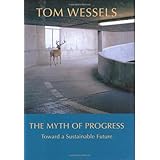
The Myth of Progress: Toward a Sustainable Future Review

The Myth of Progress: Toward a Sustainable Future
Average Reviews:

(More customer reviews)
I pulled this book from my waiting stack after reviewing Vice: Dick Cheney and the Hijacking of the American Presidency While all that we do wrong is rooted in corrupt politics such as Dick Cheney represents so well, I wanted to get away from the personalities and focus on the underlying truths of the greatest challenge facing all of us, preserving the planet for future generations.
This thoughtful careful author from New Hampshire has created a really special book, small, readable, and packed with fact (superb footnotes). He gives all due credit to his predecessors in the field--Georgescu-Roegen, Meadows, Dalay, Hawken et al.
He brings out the nuances of complex systems and how our linear reductionist thinking, and our false assumption that technology will resolve our waste creation and earth consumption issues, combine to place all that we love at risk. I was personally surprised to learn that even if we fund 100 water desalination or decontamination plants, and resolve our shortfalls of clean water, that the energy required to do so would result in entropy and further losses.
The author brings up the need for better metrics (see my reviews of "Ecology of Commerce" and "Natural Capitalism" as well as my list on "True Cost" readings. He points out that the GDP does not reflect the non-cash economy or the degree of equality/inequality in the distribution of new wealth. I would add to that the importance of counting prisons and hospitals as negatives rather than positives.
A good portion of the book (a chapter for each) is spent discussion the three fundamentals: the limits to growth; the second law of thermodynamics (entropy); and the nuances of self-organization and what happens when you reduce diversity.
The author lists the attributes of complex systems as being emergent properties that arise from the interactions (i.e. the space between the objects); self-organization, nestedness, and bifurcation into either positive or negative consequences.
The bottom line for the first part of the book is that in complex systems, especially complex systems for which we have a very incomplete and imperfect understanding, "control" is a myth, just as "progress" is a myth if you are consuming your seed corn.
The author excels at a review of the literature and demonstrating the flaws of economic theories that are divorced from reality and the "true cost" of goods and services (e.g. a T-shirt holds 4000 liters of virtual water, a chesseburger 6.5 gallons of fuel).
I have reviewed a number of books on climate change, in this book the author makes the very important point that the annual cost of weather disasters has been steadily increasing, and is the annual hidden "tax" on our reductionist approach to clearing the earth, losing the forests and mashlands, and so on.
He points out that concealing or ignoring true cost does not make it any less true, it simply passes the cost on to future generations. In the same vein he is optemistic in that he believes that if we take positive action now, however small, the benefits of that action as the years scale out, will be enormous.
This is actually an upbeat book for two reasons: first, it makes it crystal clear that the classical economics that have allowed corporations to pilage the world, bribe dictators and other elites, and generally harvest profit at the expense of the commonwealth; and second, it ends on a note of hope, on the belief that we may be approaching a dramatic cultural shift that embraces reciprocal altruism, true cost calculations, equitable wealth distribution, and so on.
He cites other authors but gives very positive insights into public ownership (by stakeholders, not the government), essentially repealing the flawed court-awarded "personality" of corporations, and re-connecting every entity to its land-base and the people it serves. He recommends, and I am buying, David Korten's "Post-Corporate World." By restoring the populace to the decision process, we stamp down the greed that can flourish in isolation.
The book ends hoping for a cultural shift from consumption to connection. I believe it is coming. Serious games/games for change, fed by real-world real-time content from public intelligence providers including the vast social networks from Wikipedia to MeetOn to the Moral Majority, could great a wonderfully distributed system of informed democratic governance that implements what I call "reality-based budgeting," budgeting that is transparent, accountable, and balanced.
This is a much more important book than its size and length might suggest. It is beikng read by and was recommended to me by some heavy hitters in the strategic thinking realm, and I am disappointed at the lack of reviews thus far. This book merits broad reading and discussion.
See also:
A Power Governments Cannot Suppress
The Unconquerable World: Power, Nonviolence, and the Will of the People
Society's Breakthrough!: Releasing Essential Wisdom and Virtue in All the People
Escaping the Matrix: How We the People can change the world
All Rise: Somebodies, Nobodies, and the Politics of Dignity (BK Currents)
Imagine: What America Could Be in the 21st Century
The Cultural Creatives: How 50 Million People Are Changing the World
The Average American: The Extraordinary Search for the Nation's Most Ordinary Citizen

Click Here to see more reviews about: The Myth of Progress: Toward a Sustainable Future


Buy Now

Click here for more information about The Myth of Progress: Toward a Sustainable Future

Read More...

The Lifecycle of Software Objects Review

The Lifecycle of Software Objects
Average Reviews:

(More customer reviews)
Everything else I've read by Ted Chiang has been a slam-dunk work of genius, where all the conceptual threads get tied up in some amazing way. This book is not like that, which is both good and bad. The conceptual stuff here isn't as unique as in his previous work - this territory has been mined, in various ways, going at least as far back as the Asimov robot novels. Nonetheless, Chiang gives an interesting spin on it. The strength of the book is that it sets up a scenario that feels much more real and grounded in human emotion and motivation than his other works have been - more so than most contemporary science fiction, for that matter. The problem is, we don't actually get the character development that the story cries out for. This is a story that, unlike his previous stories, doesn't actually fully work as a conceptual sketch, despite the rich possibilities hinted at. Maybe Chiang has outgrown the short story format, and for some reason hasn't elected to take the plunge into a true novel, which this could easily have been, and a great one at that. So let me throw out some unsolicited advice: Ted, quit your day job and go for it. If this is what your sketch of a novel looks like, I'm already sold on the real thing.

Click Here to see more reviews about: The Lifecycle of Software Objects


Buy Now

Click here for more information about The Lifecycle of Software Objects

Read More...

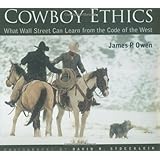
Cowboy Ethics: What Wall Street Can Learn From The Code Of The West Review

Cowboy Ethics: What Wall Street Can Learn From The Code Of The West
Average Reviews:

(More customer reviews)
I wasn't sure what to expect when I ordered the book. Upon receiving it, I couldn't put it down. This book is a full dose of downhome cowboy common moral sense combined with stuningly beautiful western photography. The book was purchased as a gift for a real cowboy friend of mine. This man who made much of his living on the back of a horse opened the book, paged through it and put it down. Within a minute or so, he picked the book up and paged through it again. He was hooked! The traditional wisdom and astonishing photography makes this book something you want to give your children and best friends. If you have any doubts look to the end of the book at the photo of the mounted cowboy carrying a calf in a snowstorm. If that doesn't sell you, nothing will.

Click Here to see more reviews about: Cowboy Ethics: What Wall Street Can Learn From The Code Of The West


Buy Now

Click here for more information about Cowboy Ethics: What Wall Street Can Learn From The Code Of The West

Read More...

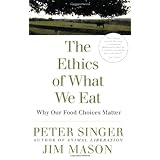
The Ethics of What We Eat: Why Our Food Choices Matter Review

The Ethics of What We Eat: Why Our Food Choices Matter
Average Reviews:

(More customer reviews)
Philosophy has rarely considered the ethics of what we eat, because until very recently, we largely ate food grown on family farms and two generations ago most people were still pretty well acquainted with where their food came from. (Most grandparents or at least great grandparents have churned butter, pluicked a chicken, etc.) In today's world everything is pre-packaged and because we no longer have to think about it, we don't. The truth is we probably don't like or want to think about how the food gets to the supermarket. After all, it's tough enough to try and plan and shop for meals and then throw together something after a long day at the office. Add in trying to think about health concerns, trying to manage on a budget and hey, we have enough to worry about, right?
But it bothered me that I knew full well that if I had to kill my own food I would be a vegetarian...yet I love meat and just didn't want to give it up. So the last few years I bought organic and grass fed and cage free...and yet, I wondered, given all the articles about the meaninglessness of labels and the lack of real standards, am I paying more just to feel like maybe the animals are treated better, when in fact there is no difference? How bad have things gotten? Basically, bad enough that I feel I have to invest energy in changing my habits, or ok enough I can continue trying to focus on organics and grass fed/cage free meat and dairy, and that's enough for me?
I was hoping this book would help me answer that question. The truth is, I didn't look forward to reading it - I didn't want something preaching or someone trying throughout to get me to go vegan (great goal, don't know that I'm up for the task though). I am pleased to report that I didn't find it preachy and actually, it was quite an interesting read. There are some things I wish were covered that aren't, but I think the approach of selecting three families and looking at what they buy, then going behind the scenes and discussing the impacts of their choices, was well done.
If you enjoy philosophy and have any leanings, as I did, to consider more carefully the issue of today's diet and what you eat, I recommend this book. It can be hard to read in places. You don't want to believe how bad conditions really are in some factory animal farming - you kind of don't want to know - bit that doesn't mean you shouldn't know.
Ignorance is bliss. Reading this is not. But I would rather make informed choices and know the truth than continue to not think about the choices I make in the supermarket. If you decide to make changes, it's not that hard, as this book let's you know what to look for and questions to ask. For example, I was aware that beef needs to be not only grass fed, but ideally grass finished, but I never asked my organic beef grower about slaughter procedures used. And, I didn't know that when considering eggs I should look into not only free range free, but at are the chickens debeaked? I have a lot more information that I can use as a consumer to make smart choices after reading this book, both about vegetable and meat products. I have not had a problem going to local growers or producers and getting my questions answered, and if you want to be informed this book will help you make choices in your everyday food selections that benefit the environment and prevent creulty to animals. How far you go with it is entirely your choice. Topics covered include environmental impacts, third world country economics, worker conditions, fair trade, and animal living conditions as well as animal creulty.
It would be great if this topic were introduced in modern college ethics courses and if we all had time to learn about why our food choices do matter. This book offers something others don't along those lines and if you are an analytical or thoughtful person, or just want to know more about how what you buy in your weekly shopping trip affects the planet and the animals on it, it's worth your time.

Click Here to see more reviews about: The Ethics of What We Eat: Why Our Food Choices Matter


Buy Now

Click here for more information about The Ethics of What We Eat: Why Our Food Choices Matter

Read More...