Money Mischief: Episodes in Monetary History Review

Money Mischief: Episodes in Monetary History
Average Reviews:

(More customer reviews)
In his best selling study, Robert L. Heilbroner calls Economists 'The worldly philosophers'. That description certainly captures what Milton Friedman does in this book - he takes the seemingly simple concept of money, the unit of exchange we use daily and rarely reflect upon, and demonstrates how complicated the issues regarding it are.

(As an interesting aside, Heilbroner's original title for his book was 'the money philosophers' - a definition that fits Friedman in this book even better then his chosen title, even if it is too narrow to account for all of economics).
More then half of this collection of essays is about the so-called 'Crime of 1873' - America's decision, following the issuance of fiat money (that is, money irredeemable in specie) during the Civil War, to peg the dollar not to both silver and gold, but to gold alone. This seemingly arcane and academic topic was a major political issue in the 1880s and 90s, climaxing with the nomination of the silver Democrat, William Jennings Bryan to the presidency of the United States in 1896.
As the Unites States, along with most other 19th century nations such as Germany and France, followed Great Britain in adopting the gold standard, the price of gold rose in terms of other resources, so prices went down. Therefore there was a severe deflation causing much unrest and discontent.
The cure to the deflation came not through political or monetary means, however, but because of an invention of a method to extract gold from low grade ore. This increased the supply of gold, lowered its prices. Hence stopping the deflation, and killing the presidential ambitions of William Jennings Bryan.
The rest of the book describes various issues, from FDR's decision to 'help silver' which helped Communism in China instead (by increasing the cost of silver, overvaluing the Chinese currency and thus hurting Chinese exports and undermining the Chinese economy), to the policy of pegging a currency to the dollar (not a good idea as it subjects the country to the whims of the world economy. The policy was a grave failure to Chile and a great success to Israel, due entirely to external changes in the value of the dollar).
The theme of the later parts of the book is undoubtedly inflation. Friedman demonstrates his claim that inflation is "always and everywhere a monetary phenomenon" (p.104). Inflation is caused by government increasing the money supply, although one time price increases may be caused by unfortunate outside events (like Arabs reduction of the exportation of oil in the early 1979s).
Although Friedman is well known as an economic right winger, there is nothing in this account that should be displeasing to anyone from the left - Friedman's case is against mismanagement, not for small or big governments. Nor is there any argument about whether government spending should go to the military, to welfare, or to any other cause. Although Friedman's book is filled with stories of the political economy, its moral is politically neutral. Indeed, Friedman clearly discusses how inflation is often used by governments because direct taxation is unpopular (p.205) - can you say "read my lips, no new taxes"?
Furthermore, the economic analysis of some reviewers in Amazon is shaky. Friedman writes "all these adjustments [the negative effects of inflation] are set in motion by changes in the rates of monetary growth and inflation. If monetary growth was high but steady... the economy would adjust to it. ... Such an inflation would do no great harm " (p.222).
Although Friedman does not like inflation, he actually makes a case for it, at least at a low single digit level. Since people are usually sellers of few things and purchasers of many, they are more aware of the increase in the price of the commodity they sell then they are of the increase of general prices, especially when those changes are low. People like to see their income go up, as they feel it is a just reward for their efforts (p. 70).
'Money Mischief' is an interesting, challenging book. Its chapters vary from the extremely technical and difficult, (notably chapter 4, a counter-factual exercise estimating the effect of continuing bimetallism after 1873), to 'pop economics' chapters which are no less enlightening and easier to read.
The book ends with a discussion of the new experiment started in the 1970s - currency which is entirely unredeemable by any kind of good. Earlier economists thought that this was impossible, and would necessarily lead to high inflation, but Friedman is optimistic - he believes that aware and well informed public and decision makers can pressure the government against unduly increasing the money supply. Thus, widespread understanding of economics is the real cure for inflation.

Click Here to see more reviews about: Money Mischief: Episodes in Monetary History


Buy Now

Click here for more information about Money Mischief: Episodes in Monetary History

Read More...

14 Cows for America Review

14 Cows for America
Average Reviews:

(More customer reviews)
As with any tragedy, in the years following the wake of September 11th a spate of books came out discussing, dissecting, and generally trying to make sense of what occurred. In this the children's literary world and the adult literary world were very much alike. Picture books in particular took a great deal of interest in making the events palatable to young impressionable minds. The results were mixed. The general consensus was to write titles that focused on the human moments that surrounded the tragedy. That adorable little fireboat that helped put out the blazes in Maira Kalman's almost too cute Fireboat. The women who could not deliver their roses, and so created an impromptu memorial in Jeannette Winter's September Roses. Best of these was Mordecai Gerstein's The Man Who Walked Between the Towers, the tragedy was merely tangential to the real story. These books all came out within a few years of one another and then nothing. It was as if people didn't feel inclined or capable of coming up with something new. Then comes 14 Cows for America. By rights, this book should not work. That it succeeds as magnificently as it does is a credit to each one of its three creators.
One day a young man named Kimeli returns to the village where he grew up. Kimeli is Maasai and he has been studying in New York to become a doctor. However, the events of September 11th are still with him, and later he tells his people the story of that horror of that particular day. Kimeli tells the elders that he will offer his cow to the people of America. The elders agree, but invite a diplomat from the United States Embassy in Nairobi to visit the village. When the diplomat comes he is greeted with a full ceremony and is presented with not one, but fourteen cows. A Note from Kimeli himself at the end explains how all this came to be, and says that "These sacred, healing cows can never be slaughtered," and will be kept under Maasai care in Kenya.
Carmen Agra Deedy has done a remarkable job with the text. Now, I will admit that I walked into this book skeptical, because I was not the world's biggest fan of her The Yellow Star. That was a book that took a myth and turned it into a story that, to those not reading closely, could have been interpreted as fact. To take this true story and give it the right tone and temper . . . well, to be perfectly frank I wasn't sure what to expect. As it turned out, I needn't have worried. This isn't a book where an author heard a story, thought it would make a great picture book, and then wrote the tale entirely on her own with minimal input from the people directly involved. Deedy collaborated directly with the book's protagonist, Wilson Kimeli Naiyomah to give this story its factual background. In the Spring of 2002 Deedy picked up her copy of The New York Times and read this story about the Maasai. Over the years she continued to collect information and eventually she got in touch with Naiyomah. They emailed back and forth and result is the book we have today.
The remarkable thing about the storytelling is that the little human facts make it interesting, but without ever sounding condescending. It would be all too easy to turn this into a story where the Maasai come off looking like magical saintly people who do this grand deed because they are not of this world. Deedy strives instead to make them infinitely human and relatable. To do this, she first needs to make it perfectly clear what the cow represents to them, so the term "the cow is life" is invoked. Kimeli is the detail that sets the book apart, of course. He is the tie that binds. Without him, this would be like any other story told about an insular group by an outsider. With Kimeli you are inside the story with the Maasai, and you are given a deeper understanding of a symbolic gesture. Deedy grounds her tale in the real world, then finds just the right words. It takes a real author to know how to finish a tale of this sort perfectly, but Deedy's last sentence takes the cake. "Because there is no nation so powerful it cannot be wounded, nor a people so small they cannot offer mighty comfort."
Like Deedy, Gonzalez is also originally from Cuba, a fact that I found particularly interesting. In her Author blurb, Deedy says of herself "she came to the United States as a refugee and like most immigrants sees the world from multiple perspectives." Gonzalez does not discuss his perspective in his blurb, but it's clear that with this book he has debuted with something remarkably strong. His background is in graphic design and art direction and as a Georgia resident it's just remarkably lucky that he happened to be near the Atlanta-based Peachtree publisher. Now he has a picture book to his name that is far and away one of the most beautiful out there. The illustrations you find here are created in pastel, colored pencil, and airbrush. The result are these rich, full colors that transition beautifully between the early morning gloom of a jeep headed to a village on one page and the full-throttle reds and vibrant colors of a ritual on the next.
The artist also eschews stereotype and the easy way out. His images have the feel of a documentary, as well as a work of art. Like Deedy, Gonzalez acknowledges that these are warriors we're talking about. In one two-page spread you see just the heads of two men, one of them with their face in shadow, just the eyes looking steadily at the reader. These aren't people you mess with but, as the text says, "They are fierce when provoked, but easily moved to kindness when they hear of suffering or injustice."
Gonzalez is at his cleverest when he must invoke the feel of September 11th without actually showing it. This is something picture books about 9/11 have to do on a regular basis, but none of the books about that day have been quite so clever about presenting the incident visually. When Kimeli tells his story the reader is on the same level as the village children, looking up. Most of the two-page spread consists of the sky above with Kimeli lifting his arms in the telling of his tale. Above him, the sky is gray with streaks of red and orange. For anyone familiar with the images of September 11th, such colors are instantly recognizable. Gonzalez has taken a day, reduced it to color alone, and then placed it harmlessly in an African sky where it illustrates a terrible tale. It is the smartest illustration choice I have seen in a very long time. For that image alone, the book should win some awards. Of course, there is one shot of the towers burning in the eyes of a Maasai child at the end of the book, but that picture is far less powerful than the preceding image and, in fact, feels a bit superfluous in comparison.
I did hear one criticism of this book that I thought was fairly on point. Non-fiction books for kids walk a tricky line between telling their stories for their child audiences and telling stories for the adults who are actually buying these books in the first place. To bridge this gap, many times an author will tell their story for the kids at the start, then follow up their story in the Afterword or Author's Note at the end for the adults. This doesn't have to happen, of course. In The Wall: Growing Up Behind the Iron Curtain (Caldecott Honor Book) by Peter Sis, for example, the author cleverly created two narratives, one old and one young, so that kids of different ages and reading levels could all get something out of the material. The argument has been made that in the case of 14 Cows for America there are facts mentioned in the "Note from Kimeli Naiyomah" that should really have been in the text. Facts like what eventually happened to the cows (they are in Kenya "under the guidance of the revered elder Mzee Ole-Yiampoi"), which a lot of kids will be wondering when they finish this book. The kids will probably believe that when the Maasai "give" their cows to America they are physically sending the cows there, just as the King of Siam meant to sent President Lincoln elephants for the Civil War. The fact that this giving is a symbolic gesture could be better explained. And I agree that the cows' fate would have been nice to mention in the text, but I don't think the choice of including it at the end hurts the book too badly. I've read far too many non-fiction picture books where there ISN'T an Afterword or Author's Note of any sort, so at least this one is present. Should this information have been in the story? Sure. But if kids ask "What happened to the cows?" parents at least will be able to the Note and read their children what it says at the back. The option is there.
If I were to pair this book with any other, I think I might go so far as to suggest that people read 14 Cows for America alongside Lynn Barasch's rather fascinating First Come the Zebra. While Deedy's book examines the Maasai from within their own community, showing how they work with one another, Barasch's book then displays them alongside the Kikuyu and offers hope in the face of prejudice. Zebra shows that not everything is easy for the Maasai. Cows shows their concern and care for the rest of the world in spite of this.
On paper, this book shouldn't work. There are so many elements that could go horribly wrong. The story could be too treacly. The pictures too self-serving or patronizing. The writing too pandering. I'm the first person to view a book of this sort...Read more›

Click Here to see more reviews about: 14 Cows for America


Buy Now

Click here for more information about 14 Cows for America

Read More...

Invincible: The Chronicles of Nick Review

Invincible: The Chronicles of Nick
Average Reviews:

(More customer reviews)
The fate of the world is at stake, and the deciding factor between good and evil rest upon the shoulders of a teenager. Sherrilyn Kenyon's foray into the popular YA genre hits it's stride with the sophomoric release of The Chronicles of Nick series, Invincible. This second effort is definitely better than the first. We pick up where the last book left off, right after Nick and his friends defeat the zombies, and the mortents. Oh, and then there's Kyrian's flashing some fang. But who and what his so called friends and allies are, are not the only obstacles Nick will be facing. The pressure is on for Nick to start mastering his powers, because there's a bounty on his head, and no shortage of demons trying to collect. His love life has gone from not to hot, trying to decide between the girl he's pined for in the past and the one who saw him when no one else did. Nick can't seem to catch a break with a new principal who's even worst than the last one. Gautier can't even put a W in the win column when the new football coach wants him back on the team, since he also has even more devious extra curricular activities to add to Nick's roster. In Nick's world everyone's a player and surrounding yourself with the right people is the key to being a pawn or a king, and by the end someone close to him will be on evil's payroll. His soul is constantly teetering in the balance, as we watch on pins and needles whether the choices he makes now will sway the future.
I found the writing as witty as some of the characters. Kenyon approached this book with a sense of humor and satire that I think really fits her leading man. She really captures an innocence, curiosity, and attitude with Nick that make you want him to succeed. At the same time Invincible was a lot of fun bringing back old characters like Bubba and Mark and adding some new dimensions to them, while introducing new and interesting characters like Grim, Pain, and Suffering. Even when we were in the build up stage at the beginning of the book Kenyon kept us occupied with interesting places and people like the Sanctuary. It's a great vibrant world set in an equally lively and tragic city, that mirrors Nick's character. There isn't a dull moment in the life of Nick and by the end we'll all be rooting for the underdog.
I opted for the audiobook for Invincible, which was excellent. The narrator Holter Graham was wonderful.Graham made the words come to life. He doesn't sound too old, and he captures Nick's personality. I highly recommend the audio version if you get the chance. If not, well you can't go wrong with a great world, wonderful characters, and interesting storylines. The ending will have you wondering what's next and how Nick's going to deal with the relentless revelations.

Click Here to see more reviews about: Invincible: The Chronicles of Nick

Nick Gautier's day just keeps getting better and better. Yeah, he survived the zombie attacks, only to wake up and find himself enslaved to a world of shapeshifters and demons out to claim his soul.His new principal thinks he's even more of a hoodlum than the last one, his coach is trying to recruit him to things he can't even mention and the girl he's not seeing, but is, has secrets that terrify him. But more than that, he's being groomed by the darkest of powers and if he doesn't learn how to raise the dead by the end of the week, he will become one of them...

Buy Now

Click here for more information about Invincible: The Chronicles of Nick

Read More...

Building Websites with ExpressionEngine 2 Review

Building Websites with ExpressionEngine 2
Average Reviews:

(More customer reviews)
I recently read through Building Websites with ExpressionEngine 2, by Leonard Murphy.
As one of the first books out to cover the relatively recently released ExpressionEngine 2, I was eager to get my hands on it. I've found before that reading through books, such as Michael Boyink's, Building an ExpressionEngine 2 Site for Small Business, has been instrumental in developing a set of standards to use as I develop sites in ExpressionEngine 2.
In case you aren't familiar with the product, ExpressionEngine 2, released in July of this year, is the latest release of EllisLab's flagship content management system. The tool is extremely powerful, and is a top choice of web designers and developers for site-building projects that might otherwise resort the such CMSs as WordPress, Drupal, Joomla and the like. While ExpressionEngine isn't free, and many of it's top addons are commercial as well, they come with professional support, which more than makes up for the initial cost outset when you run into a bind along the way. ExpressionEngine allows you to work with your content in an entirely different way than other content management systems, completely separating it from the design, and this has led to a very active and dedicated fan-base.
With the power and flexibility of a complex and mature tool, such as ExpressionEngine, comes the challenge of working efficiently. In a wide-open playing field, one must set his or her own rules and standards, so that it's easy to go back to a site you worked on several months ago and still know how it works. This has been the topic of sessions at the EECI conferences, such this one by Leevi Graham.
It's in this area also, that I've found books such as Building Websites with ExpressionEngine 2 immensely helpful. Murphy's new book is a good choice for the beginning ExpressionEngine user. It covers all the basics for a user who needs a little hand-holding. I appreciate that it also goes beyond the basics, with a chapter about implementing ExpressionEngine's powerful membership features, both for control panel administration, and front-end site membership.
As any developer familiar with ExpressionEngine will tell you, one of the greatest features of the tool is its ability to be extended through add-ons. There's a huge library of them available at Devot:ee, the ExpressionEngine community site, and it becomes a vital part of the development workflow to find appropriate add-ons for a given project. The end of the book includes an overview of several popular ExpressionEngine add-ons, which is fantastic. It's extremely important to get a firm grasp of the available add-ons before really digging into ExpressionEngine.
While this book certainly isn't the one for you if you're already a seasoned ExpressionEngine user, I think any new user will find its contents valuable as they begin using the tool.

Click Here to see more reviews about: Building Websites with ExpressionEngine 2

This book is a clear and enjoyable tutorial packed with carefully explained steps for constructing a small business website, and information for applying the skills learned to your everyday work with ExpressionEngine. If you have familiarity with building websites using HTML/CSS or with software such as DreamWeaver or other content management systems such as Drupal, WordPress, Joomla!, or Plone, then ExpressionEngine may be what you are looking for. This book is suitable for anyone who wants to develop a fully featured web presence with a simple and straightforward tool. No prior knowledge of content management systems, PHP or ExpressionEngine is assumed. A basic understanding of HTML is necessary to follow the examples.

Buy Now

Click here for more information about Building Websites with ExpressionEngine 2

Read More...

Letters from a Stoic (Penguin Classics) Review

Letters from a Stoic (Penguin Classics)
Average Reviews:

(More customer reviews)
The first time I read this book I was amazed and excited, and entering middle age. Seneca's thoughts on the human condition seemed like they could have been written today. Except for some dated Roman references, here is a man trying to define how to live, in what we today would call "the secular society." The series of letters reads like a personal guidebook to ethics. It still speaks to us across the centuries. Seneca was priveleged, ego centric, and all too aware of the fleeting nature of life. He was also a tutor of Nero, a dramatist, philosopher, slave owner, etc. But his essay-like letters - by turns glib and medatative - reveal a man struggling to make sense of a world of power, wealth and abundance, oestensibly ruled by reason, suffused with uncertainty and enveloped in paganism. He was also no doubt polishing his image for future generations. Nonetheless, he talks of god and spirituality, and the early Christians were said to have valued his wisdom. I've read this two or three times. Each time I've given it away to a friend. Once you read it, you'll go back to it again and again. His maxims are famous. His commonsense advice still rings true.

Click Here to see more reviews about: Letters from a Stoic (Penguin Classics)

A philosophy that saw self-possession as the key to an existence lived 'in accordance with nature', Stoicism called for the restraint of animal instincts and the severing of emotional ties. These beliefs were formulated by the Athenian followers of Zeno in the fourth century BC, but it was in Seneca (c. 4 BC - AD 65) that the Stoics found their most eloquent advocate. Stoicism, as expressed in the Letters, helped ease pagan Rome's transition to Christianity, for it upholds upright ethical ideals and extols virtuous living, as well as expressing disgust for the harsh treatment of slaves and the inhumane slaughters witnessed in the Roman arenas. Seneca's major contribution to a seemingly unsympathetic creed was to transform it into a powerfully moving and inspiring declaration of the dignity of the individual mind.

Buy Now

Click here for more information about Letters from a Stoic (Penguin Classics)

Read More...

Madrigal's Magic Key to Spanish: A Creative and Proven Approach Review

Madrigal's Magic Key to Spanish: A Creative and Proven Approach
Average Reviews:

(More customer reviews)
I got decent grades in college Spanish; two "A-‘s" and a "B+." However, when I needed to actually speak Spanish, I was lost. I couldn't say much except "Mas cervezas, por favor (More beer, please)!"
"Madrial's Magic Key", along with the expensive (but quite worth it) Pimsleur tapes, have corrected the "mis-education" I was subjected to. The drills Ms. Madrigal presents are easy to remember and fun to do, not like those tedious translations and verb conjugations that college texts are so fond of. In two months, studying this book in my spare time, I retained more Spanish than I did in an entire academic year. And, for the first time, I can actually say that I understand Spanish.
I would supplement this book with a comprehensive book on Spanish grammar (I have the Barron's, but I suppose any would work) and a dictionary. I would definitely recommend "Breaking Out of Beginner's Spanish" by Joseph Keenan for an in depth take on colloquial Spanish as well. Further, if you have the money, buy the "Pimsleur Comprehensive" series as well. Get vol.'s 1-3, even though they are pricey. If you are an audio/tactile learner like me, I guarantee that you will retain more Spanish idioms using the Pimsleur method than any other.

Click Here to see more reviews about: Madrigal's Magic Key to Spanish: A Creative and Proven Approach

Anyone can read, write, and speak Spanish in only a few short weeks with this unique and proven method, which completely eliminates rote memorization and boring drills.

Buy Now

Click here for more information about Madrigal's Magic Key to Spanish: A Creative and Proven Approach

Read More...

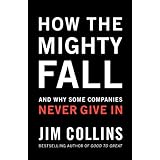
How The Mighty Fall: And Why Some Companies Never Give In Review

How The Mighty Fall: And Why Some Companies Never Give In
Average Reviews:

(More customer reviews)
Let me preface this review by saying that I am a fan of Collins' earlier work. Built to Last was a great book, and Good to Great was very good. How the Mighty Fall, however, is neither. The issue of corporate failure is critical, particularly in the current downturn. Unfortunately, the core of Collins' analysis in this book is flawed.
How the Mighty Fall addresses two related questions: Why do good companies fail? and how does management respond once a company gets into trouble? Collins introduces a five stage model to answer these questions, where steps one and two address the roots of corporate failure and steps three through five managements' response.
Collins' analysis of management response to decline--denial of risk, grasping for salvation, and capitulation to irrelevance or death--accurately describe how leaders respond to deterioration in their business. This analysis here is solid, the writing clear, and the tempo brisk. Collins does a particularly good job of describing dysfunctional leadership behaviors of companies is in decline.
Collins' analysis of why companies get into trouble in the first place is much less compelling. Companies fail, according to Collins, when success breeds managerial hubris, which leads to overreach and ultimately failure. Like many of Collins' findings, this makes intuitive sense. Unfortunately in this case, his core argument runs counter to research on hundreds of companies, conducted over decades by dozens of scholars. There are two major flaws in Collins argument.
First, he claims that companies get into trouble because they overreach and expand beyond their core. This is consistent with data showing that diversified companies trade at a discount to focused rivals. Recent research published in the Journal of Financial Economics and the Journal of Finance has established that the companies often diversify to escape decline in their core business. Overreach is a symptom--not a cause--of decline and thus cannot explain its roots.
Second, Collins ignores a rich body of research that finds decline sets in not because companies stray from their core, but because they stick too close to it. Clay Christensen's research on disruptive technology, for example, demonstrates that companies stumble when they stay too close to their established customers and fail to serve emerging segments. The competency trap literature finds that companies get locked in by what they do well and struggle to adapt when circumstances change. Hubris and overreach, of course, play a role in corporate decline, but a well-established body of research suggests that they are rarely the root causes.
How did Collins, who does many things right in his research, get his core finding so wrong in this case? As always he tackles a big and important question, and his pairing of comparable companies is a sensible research design. His failure to read or acknowledge a rich body of previous research that bears directly on his research question, in this case, has led him to rather facile observations. In research, as in business, a lack of humility in recognizing the contributions of others can lead to overreach.


Click Here to see more reviews about: How The Mighty Fall: And Why Some Companies Never Give In


Decline can be avoided. Decline can be detected. Decline can be reversed.

Amidst the desolate landscape of fallen great companies, Jim Collins began to wonder: How do the mighty fall? Can decline be detected early and avoided? How far can a company fall before the path toward doom becomes inevitable and unshakable? How can companies reverse course?

In How the Mighty Fall, Collins confronts these questions, offering leaders the well-founded hope that they can learn how to stave off decline and, if they find themselves falling, reverse their course. Collins' research project—more than four years in duration—uncovered five step-wise stages of decline:
Stage 1: Hubris Born of Success Stage 2: Undisciplined Pursuit of More Stage 3: Denial of Risk and Peril Stage 4: Grasping for Salvation Stage 5: Capitulation to Irrelevance or Death
By understanding these stages of decline, leaders can substantially reduce their chances of falling all the way to the bottom. Great companies can stumble, badly, and recover.

Every institution, no matter how great, is vulnerable to decline. There is no law of nature that the most powerful will inevitably remain at the top. Anyone can fall and most eventually do. But, as Collins' research emphasizes, some companies do indeed recover—in some cases, coming back even stronger—even after having crashed into the depths of Stage 4.

Decline, it turns out, is largely self-inflicted, and the path to recovery lies largely within our own hands. We are not imprisoned by our circumstances, our history, or even our staggering defeats along the way. As long as we never get entirely knocked out of the game, hope always remains. The mighty can fall, but they can often rise again.


Buy Now

Click here for more information about How The Mighty Fall: And Why Some Companies Never Give In

Read More...