Showing posts with label wwii pacific. Show all posts

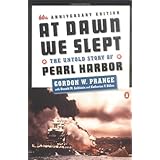
At Dawn We Slept: The Untold Story of Pearl Harbor Review

At Dawn We Slept: The Untold Story of Pearl Harbor
Average Reviews:

(More customer reviews)
While science is my area of expertise, I have a continuing interest in history. That interest lead me to pick up Prange's book. Gordon Prange has devoted years to accumulating information about the Japanese attack on Pearl Harbor. That information includes interviews and military and government information from the USA and Japan. That accumulated information was then boiled down into this final work -- completed after Prange's death.
While there have been many books and theories proposed about why and how the debacle at Pearl Harbor took place, Prange's approach is well documented, and includes details of the pre-attack politics of the USA and of Japan. His book also includes detailed information about the attack itself, gleaned from interviews with those on both sides who actually participated in the event. But, even with that level of detail, I must admit that the most compelling part of the book for me is the section that follows the actual attack -- when the US government and the military were trying to figure out what actually happened, and who was to blame.
The final series of chapters of the book provide insight into the thoughts and tactics of Adm. Kimmell (CincPAC) and Gen Short (Commanding General of army at Hawaii), the two primary "interested parties" in the event.
Before reading the book, I had a tendency to believe that there may have been something of a conspiracy by the Roosevelt administration to get us into WWII, but after reading this account of Pearl Harbor, I am more likely to believe that the great success, including complete surprise by Japanese naval aviation was the result of a series of ill-advised decisions by the commanders at Hawaii rather than by any entity in Wash DC.
The sticky point in the whole affair was "magic" the US's code-breaking machine that allowed us to monitor coded diplomatic messages sent between Tokyo and some of its embassies. While "magic" was the source of a great deal of information that may have resulted in a different outcome at Pearl Harbor if the commanders there had access to it, we will never really know.
If you are interested in looking in repurcussions from the attack at Pearl Harbor, or if you have an interest in thinking about the whys and hows of the US entry into WWII, I urge you to read this book.
The writing is passable, though sometimes quite dry. The information is well documented, and is believable. This is not, however, a quick read -- there is a lot of meat in this book to be digested as you go along.
All in all an outstanding contribution to the telling of a sensitive piece of American history.
5 stars for content and believability.
Alan Holyoak

Click Here to see more reviews about: At Dawn We Slept: The Untold Story of Pearl Harbor


Buy Now

Click here for more information about At Dawn We Slept: The Untold Story of Pearl Harbor

Read More...

Eagle Against the Sun: The American War With Japan Review

Eagle Against the Sun: The American War With Japan
Average Reviews:

(More customer reviews)
Good books devoting themselves to the overall scope and breadth of Pacific campaign against the Japanese during World War Two are hard to find, but this book solves the reader's problem nicely. It is a comprehensive, entertaining, and fair-minded book that careful details both Japanese and Allied perspectives before, during, and at the conclusion of the war. This book is truly a carefully constructed, exhaustively researched and quite well documented one-volume history that everyone should love. I first discovered it on the syllabus of a graduate-level Harvard history course, and have had it on my shelf ever since. Written in a very accessible style that allows the reader to stream through as though one is reading a novel, and it is filled with interesting anecdotes and new insights that keep the reader entertained and interested throughout the nearly 600 pages of the book. My own personal favorite was an actual complaint filed immediately after the attack at Pearl Harbor by a Hawaiian resident of a dog who was allegedly barking in Morse code to the Japanese ships offshore. It is also offers a number of new thought provoking and intriguing ideas about aspects of the war against Japan for the reader.
The author engages in an active reinterpretation of the war based on declassified intelligence files, archival material, Japanese documents and an impressive collection of interviews with principals involved in the almost five year struggle to defeat the Japanese after the events at Pearl Harbor. It is interesting to learn that the U.S. planned to wage a wide-ranging campaign of submarine attacks against enemy shipping even before the start of the war, and also indicates that MacArthur was lucky not to be unceremoniously dumped after his bad bungling of the defense of the Philippines and also because of his active disregard for a number of important intercepts of Japanese messages that could have saved literally thousands of American and other lives. Spector also reveals that U.S. decisions were often more influenced by the nature of our stormy relationship with our British allies and our own inter-service rivalries than by strategic concerns.
The author vividly conjures up accurate and spell-binding accounts of the major battles of the war, and provides a number of intriguing descriptions of lesser known aspects of the Pacific campaign, as well. He takes the reader on a fascinating whirlwind tour of the war, leaping from details of critical meetings between war planners in the Pentagon to social, economic, and political aspects of the engagement to excellent on-the-scene coverage of the battlegrounds. He shows us how the war against the Japanese was different from that being waged in Europe, and how this intensely naval type of conflict was in a number of ways much more risky and innovative on our part than its European counterpart. I was particularly fascinated by his interesting argument that the most critical Japanese mistake of the war was in allowing itself to be drawn into fighting the war of attrition we had always preferred to wage based on its defeat at Midway. This is an important, magisterial, and comprehensive book that is undoubtedly the single best one-volume treatment of the war against Japan and it belongs on every serious World War Two student's bookshelf. Enjoy!

Click Here to see more reviews about: Eagle Against the Sun: The American War With Japan


Buy Now

Click here for more information about Eagle Against the Sun: The American War With Japan

Read More...