Showing posts with label economic development. Show all posts

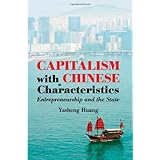
Capitalism with Chinese Characteristics: Entrepreneurship and the State Review

Capitalism with Chinese Characteristics: Entrepreneurship and the State
Average Reviews:

(More customer reviews)
Professor Huang has written a brilliant critique of China's economic development (and of necessity, debunks much of what others have written about China's economy). He shows that China's development started in the 1980's with government programs focused on the rural economy, with programs designed to encourage rural entrepreneurs. Unfortunately with the Tiananmen Square crackdown, the new government leaders (technocrats from Shanghai) focused on major programs for urban areas, including massive construction projects and encouragement of foreign investment. Rural enterprises (and their required informal and official funding networks) were shut down. Although there was a proliferation of highrise buildings and massive construction projects (Three Gorges Dam, Shanghai's maglev, the Olympics,...) the result was slower income growth (especially in the rural areas), increasing illiteracy (parents could not afford to pay rapidly increasing tuitions), declining health care (hospitals, like schools, also became profit centers for local bureaucrats), expropriation of farmers' land, and much much more corruption, all of which has led to increasing social disorder among peasants who are finding themselves worse off. Party cadres' pay has rapidly increased and there are now far more of them. And productivity growth has declined or has even straight-lined. A return to the policies of the 1980's is clearly in order, but the current leaders, while trying to fix things, are still relying on top down commands and controls, and they have a much larger bureaucracy to keep happy.
Anyone trying to understand China's economic development over the last thirty years must read this. The causes of China's growth are badly misunderstand; too many economists and analysts have been overwhelmed by the vision of Shanghai's massive development without understanding the tremendous cost and waste involved, and the penalties paid by the common people (income for the poorest Shanghaiese has actually been going down).
The book should also be a lesson for Western politicians who think that China's methods of centralized planning and control of industrial policy can be applied in the West. Or maybe our politicians also understand how government control can lead to huge payoffs for politicians (as with Countrywide Credit's payoffs of at least two senators and lots of others politically connected, not to mention the huge salaries paid to Democrat politicians 'working' at Fannie Mae).
Read this book if you have any interest in China or economic development!

Click Here to see more reviews about: Capitalism with Chinese Characteristics: Entrepreneurship and the State

An Economist Book of the Year, 2008This book presents a story of two Chinas - an entrepreneurial rural China and a state-controlled urban China. In the 1980s, rural China gained the upper hand, and the result was rapid as well as broad-based growth. In the 1990s, urban China triumphed. In the 1990s, the Chinese state reversed many of its productive rural experiments, with long-lasting damage to the economy and society. A weak financial sector, income disparity, rising illiteracy, productivity slowdowns, and reduced personal income growth are the product of the capitalism with Chinese characteristics of the 1990s and beyond. While GDP grew quickly in both decades, the welfare implications of growth differed substantially. The book uses the emerging Indian miracle to debunk the widespread notion that democracy is automatically anti-growth. The single biggest obstacle to sustainable growth and financial stability in China today is its poor political governance. As the country marks its 30th anniversary of reforms in 2008, China faces some of its toughest economic challenges and substantial vulnerabilities that require fundamental institutional reforms.

Buy Now

Click here for more information about Capitalism with Chinese Characteristics: Entrepreneurship and the State

Read More...

Mismeasuring Our Lives: Why GDP Doesn't Add Up Review

Mismeasuring Our Lives: Why GDP Doesn't Add Up
Average Reviews:

(More customer reviews)
This is a very important book. Many people should read it. All who offer evaluations of how people are faring around the world, and every single politician and policy maker, needs to take its recommendations into consideration. The topic at first seems way too specialized for the general reader: why GDP -- gross domestic product, a monetary figure that claims to sum up all the goods and services produced in a country's economy and has reigned supreme as the most cited economic statistic -- is misleading as a straightforward indicator of human well-being. But this brief book is intended for a wide audience.
"Mismeasuring Our Lives" tells us, in clear, concise and non-technical language why GDP is a problematic measure, what other measurements we should use or develop, and why this is so important for all citizens to understand. The book is the report of a commission called together by French president Nicolas Sarkozy. The lead authors, who convened a broad and distinguished international panel of experts, are the Nobel Prize-winning economists Joseph Stiglitz and Amartya Sen, along with Jean-Paul Fitoussi, head of the French center for economic research. They begin by pointing out how much economic activity GDP leaves out, such as the work of a stay-at-home parent or the full benefit of government-provided health care. And GDP can be misleading: rising national output can still leave behind middle and low earners; China, despite authoritarian rule, can appear to be a "better" society than democratic India, if you just look at GDP per capita; France, with more guaranteed vacation time for workers, rates lower than the frenetic U.S.; selling more expensive, gas-guzzling SUVs raises GDP, but at the cost of raising global temperatures and reducing oil reserves.
The report suggests ways to rectify these problems, both using currently available statistics and calling for new measurements. But the commission clearly recognizes that measures of economic performance, particularly the GDP focus on market activity, do not equate to human satisfaction. So they call for a new and extensive move toward better understanding -- and measurement -- of the quality of life. A final third of the book seeks to do the same for sustainability -- how do we improve life for everyone now in such a way that we are not robbing from our children's future? As President Sarkozy points out: "We will not change our behavior unless we change the ways we measure our economic performance."

Click Here to see more reviews about: Mismeasuring Our Lives: Why GDP Doesn't Add Up

In February of 2008, amid the looming global financial crisis, President Nicolas Sarkozy of France asked Nobel Prize–winning economists Joseph Stiglitz and Amartya Sen, along with the distinguished French economist Jean Paul Fitoussi, to establish a commission of leading economists to study whether Gross Domestic Product (GDP)-the most widely used measure of economic activity-is a reliable indicator of economic and social progress. The Commission was given the further task of laying out an agenda for developing better measures.Mismeasuring Our Lives is the result of this major intellectual effort, one with pressing relevance for anyone engaged in assessing how and whether our economy is serving the needs of our society. The authors offer a sweeping assessment of the limits of GDP as a measurement of the well-being of societies-considering, for example, how GDP overlooks economic inequality (with the result that most people can be worse off even though average income is increasing); and does not factor environmental impacts into economic decisions.In place of GDP, Mismeasuring Our Lives introduces a bold new array of concepts, from sustainable measures of economic welfare, to measures of savings and wealth, to a "green GDP." At a time when policymakers worldwide are grappling with unprecedented global financial and environmental issues, here is an essential guide to measuring the things that matter.

Buy Now

Click here for more information about Mismeasuring Our Lives: Why GDP Doesn't Add Up

Read More...