Showing posts with label peak oil. Show all posts

Why Your World Is About to Get a Whole Lot Smaller: Oil and the End of Globalization Review

Why Your World Is About to Get a Whole Lot Smaller: Oil and the End of Globalization
Average Reviews:

(More customer reviews)
I read Jeff Rubin's book because I invest in energy stocks and like to know the broad societal implications of energy issues. I was fascinated by his major premise that high energy costs will end the global marketplace. It is the opposite of Tom Friedman's World is Flat premise. Rubin's basic argument is that high energy prices will trump low labor costs of developing countries. That will mean we will re-industrialize and start making things again in America. That may make us look more like 1950's America. Most economists say globalization is irreversible but Rubin disagrees. Globalization is only possible when cheap energy allows shipping anything at low cost.
There are two other books that have the same end of cheap energy theme. One is Stephen Leeb's Game Over and the other is $20 a Gallon by Chris Steiner. Leeb's book is more of an investment survival guide while Steiner's $20 a Gallon is more of a sociological portrait of America in the age of prohibitive gas prices. Leeb is rather depressing in positing the end of cheap energy and commodities in general. Leeb sees global insecurity as countries fight for resources.
Steiner sees high energy as an opportunity to re-urbanize America with close in dense communities without cars. Steiner does a great job of predicting how escalating gas prices will change our lives. He says we may be happier living a simpler less consumption oriented lifestyle.
Rubin's book is the best all round book for it covers both economics and sociology. If you want to know how to make money from energy shortages, Leeb has some valuable and practical advice. Steiner will leave you hopeful for a simpler, more community minded America. I recommend all three books without hesitation as helpful guides to an America facing a dearth of resources in the next 20 years. They certainly reinforce the need for a national energy policy now while we may be able to extend resources.

Click Here to see more reviews about: Why Your World Is About to Get a Whole Lot Smaller: Oil and the End of Globalization

An internationally renowned energy expert has written a book essential for every American–a galvanizing account of how the rising price and diminishing availability of oil are going to radically change our lives. Why Your World Is About to Get a Whole Lot Smaller is a powerful and provocative book that explores what the new global economy will look like and what it will mean for all of us.In a compelling and accessible style, Jeff Rubin reveals that despite the recent recessionary dip, oil prices will skyrocket again once the economy recovers. The fact is, worldwide oil reserves are disappearing for good. Consequently, the amount of food and other goods we get from abroad will be curtailed; long-distance driving will become a luxury and international travel rare. Globalization as we know it will reverse. The near future will be a time that, in its physical limits, may resemble the distant past.But Why Your World Is About to Get a Whole Lot Smaller is a hopeful work about how we can benefit–personally, politically, and economically–from this new reality. American industries such as steel and agriculture, for instance, will be revitalized. As well, Rubin prescribes priorities for President Obama and other leaders, from imposing carbon tariffs that will increase competition and productivity, to investing in mass transit instead of car-clogged highways, to forging "green" alliances between labor and management that will be good for both business and the air we breathe.Most passionately, Rubin recommends ways every citizen can secure this better life for himself, actions that will end our enslavement to chain-store taste and strengthen our communities and timeless human values.

Buy Now

Click here for more information about Why Your World Is About to Get a Whole Lot Smaller: Oil and the End of Globalization

Read More...

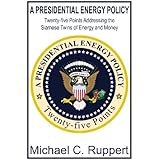
A Presidential Energy Policy: Twenty-Five Points Addressing the Siamese Twins of Energy and Money Review

A Presidential Energy Policy: Twenty-Five Points Addressing the Siamese Twins of Energy and Money
Average Reviews:

(More customer reviews)
This book explains the relationships between energy (especially oil) and finance. The book is written in a clear and straight-forward manner that makes it accessible to everyone. If you would like to understand the relationship between oil and finance, and how the present policy arrangements for these vital components of the system we live within have brought the world to the brink of financial, social and cultural collapse, then read this book.
For years Mike Ruppert has been accurately and relentlessly forecasting that unless we changed our understanding of energy and the way money works, the financial collapse we have now been witnessing would take place. His only objective has been to advise any who would listen about the paradigm shifting changes under way, and therefore how to prepare themselves in order to best survive, and even to prosper during and after the crisis.
With that in mind, in this book he explains the current crisis clearly and succinctly before setting out a policy agenda which offers a path forward - not just for shadowy multi-billionaire and multi-trillionaire bankers and their friends but for all citizens of the United States and in fact of the world. The contents of the book cover oil depletion (peak oil), electricity infrastructure, alternative energies, food, localization, money, foreign policy, and of course a twenty five point plan for addressing the most urgent issues.
To date the elected officials of the United States, whichever party they represent, seem to believe that lining the pockets of the financial elites with untold trillions worth of dollars of taxpayers money is the only policy response worth pursuing (Cynthia McKinney, Ron Paul and Roscoe Bartlett being honourable exceptions).
Yet there is always the possibility that a courageous leader will decide to represent the citizens he or she has been elected to represent, rather than unelected vested interests. By following the advice of 'A Presidential Energy Policy', such a leader has the opportunity at this critical turning point in world history, to reap a rich harvest of gratitude and praise for his or her actions that far outweighs the morally destitute rewards of money and power.
In summary, 'A Presidential Energy Policy' is a book which every person who cares about the future of the United States and the planet we live on should read and pass on to everyone they know. The crisis is well advanced, but perhaps with enough Mike Rupperts in the world sufficient elements of civilization can be salvaged to make life worth living, not just for the elite members of the financial-energy-military-industrial complex, but for all citizens of the world.
As it stands, Mike Ruppert himself stands at a minimum to personally reap a harvest of good karma for selflessly seeking to expose the way financial and energy elites exercise control over government and for explaining it to everyday people. Were the policy agenda he sets out here to be followed, however, he would also stand to achieve fitting recognition for his life's work. May it happen.

Click Here to see more reviews about: A Presidential Energy Policy: Twenty-Five Points Addressing the Siamese Twins of Energy and Money

Michael Ruppert addresses some simple but widely ignored concepts relating to the critical role of oil and gas in the modern world. First, they are finite resources, formed in the geological past, therefore subject to depletion. Second, they have to be found before they can be produced. He then goes on to address the wider implications recognizing that there is a finite Oil Age. Many claims have been made that new technology will counter the natural decline, but there is an irony: the better the technology, the faster the depletion. The book then turns to related subjects, including foreign policy and the invasion of Iraq, the hopes for renewable energy substitutes, the impact on farming and population, and the nature of Money. The impact on the economy is a central theme of the book. It gives emphasis to the U.S. situation but also covers the wider World, ending with twenty-five sensible recommendations by which the United States Government could react to the unfolding situation.

Buy Now

Click here for more information about A Presidential Energy Policy: Twenty-Five Points Addressing the Siamese Twins of Energy and Money

Read More...

Into the Forest: A Novel Review

Into the Forest: A Novel
Average Reviews:

(More customer reviews)
I'm a big fan of post holocaust fiction. I've read hundreds of stories over the past 40 years about Life after Doomsday. This is absolutely one of the best. It avoids the common assumptions of the genre. There is no sudden and dramatic change in the lives of the two young protagonists. There isn't an immediate awareness on the part of the community that something awful and terrifying is occurring. People don't suddenly go berserk. Marauding gangs of psychopaths don't appear out of nowhere to prey upon the vulnerability of their fellow citizens. Every character, every behavior, every reaction is believable and easily explained within the context of known human behavior. Everyone initially clings desperately to the belief that things haven't really changed, that the situation isn't that bad, that tomorrow, things will all return to normal. It's just a matter of holding on and continuing with their daily routines.
Hegland's placing of Nell and her sister Eva in a forest, far from the nearest town, was a brilliant device on many levels. Normally, doomsday writers place their protagonists right in the thick of things. They trap them in cities or situations where they can inflict upon them every supposedly predictable terror of life after the collapse, showing us clearly frightened people in clearly frightening times.
But Nell and Eva live in a quiet forest. The forest isn't just a location here. It's not there just to show us the girls' gardening skills or how to live a self-sufficient life. The forest is a major, living, breathing protagonist. Hegland renders it's character brilliantly. It is both serene and tumultuous, comforting and menancing, fiercely protective and neglectful. Placing Nell and her sister in this quiet, slow environment creates a constant sense of dread and tension in the story - what unknowable things are going on outside this ageless, unjudgmental sanctuary? What horrors are taking place? Are cities burning? Has the law of the jungle replaced the fragile contracts between people? Is inescapable death slowing overtaking mankind? Are all the horrors imaginable about to invade this oasis of calm, and when and how will they come? The little intrusions of the outside world that do occur are more terrifying as a result. The forest doesn't protect Nell and Eva from evil. It wreaks no havoc on transgressors, it passes no judgments, it doesn't change or adapt. "Bring it on" it seems to say. "I will not be changed. I will simply out last you, neutralize you with my steadfastness, absord your impact and accept it as part of my nature."
The forest is a sort of allegory for the the human spirit. Primieval, indestructable and unchanging, it survives despite the modern mistakes of humankind.
I disagree strongly with the reviewer who says this is not an inspirational story. It is a story filled with hope and promise. Strip away the false values, the intellectualism, the materialism and the intolerance that are so much a part of the modern human's psyche, and you are left with what got us this far to begin with, and what will save us in the end - a sense of beauty, perseverance, tolerance and acceptance of the world as it is.
It's a beautiful, poetically written story, and well worth a place on anyone's bookshelf.


Click Here to see more reviews about: Into the Forest: A Novel


Buy Now

Click here for more information about Into the Forest: A Novel

Read More...