Showing posts with label financial. Show all posts

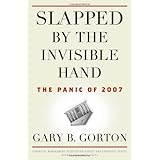
Slapped by the Invisible Hand: The Panic of 2007 (Financial Management Association Survey and Synthesis) Review

Slapped by the Invisible Hand: The Panic of 2007 (Financial Management Association Survey and Synthesis)
Average Reviews:

(More customer reviews)
Gorton has made an important contribution to the debate on the Financial Crisis (and I was eager to read his book because of it). He argues that government guarantees of retail deposits enacted in the 1930s, and not capital adequacy requirements, (temporarily) ended previously common panicked withdrawals from the entire banking system. As uninsured short-term institutional deposits have grown and become the primary source of funds for money center banking, it was just a matter of time before these runs began anew. But the book just about starts and ends there. At a critical junctures like ours, the country needs clear thinkers like Gorton to provide leadership by addressing the issues comprehensively, speaking out against demagoguery and making recommendations. Otherwise, why step to the microphone with a book instead of the papers he already published? Gordon scarcely draws conclusions and makes no substantial recommendations!
He points out why repurchase agreement failed as an alternative to government guarantees but goes no further. He shows (in many pages of unnecessary detail) that structured finance contributed to the difficulty of knowing how much (sub-prime) risk each bank held but he doesn't analyze whether credit default swaps and flawed credit ratings also contributed to the confusion. Nor does he show that the value of withdrawing funds to reduce risk in fear of others doing likewise wouldn't have occurred no matter the availability of information. He admits that better information likely would not have solved the problem but he offers no alternatives.
He claims, with little support (although surely its true) , that increased capital adequacy requirements will simply contract the boundaries of banking but he doesn't show where, speculate how the resulting unfilled customer needs with be filled and whether these alternatives would be good or bad for the economy in terms of reducing systematic risk. In this context you'd also like to hear his evaluation of convertible bank debt as an alterative solution to the problem but again, nothing. (Increased reserves would likely curtail mortgage lending.) He asserts that the reduced value of monopoly rent conferred by previously restricted bank charters caused banks to take more risk. If his recommendation is to return to something akin to the restrictions of old, it would take a lot more than just pointing out the issue to show how, why and to what effect.
If you put forward a theory, you also have to show why it's better than alternative explanations but he devotes only a couple pages to pooh-poohing the alternative theories that originate-to-distribute and misaligned incentives reduced lending standards (although I agree with his conclusions) . Except for noting that sub-prime finance served as a trigger, he never addresses the role of Freddie and Fannie in spurring on sub-prime mortgage lending and the extent to which the crisis could have been averted were that not the case. (Presumably we can infer Gordon thinks something else just would have come along.) The role of the trade deficit in the build-up of uninsured short-term institutional deposits is never mentioned. If the answer is for the government to guarantee institutional deposits should we also be guaranteeing offshore deposits into US financial institutions?
If you've read Gorton's papers, there is nothing more here. If you haven't, it's a lot to slog through for what could have been summarized in a much shorter piece. Sentences like, "This agent cares about the intertemporal marginal rate of substitution, so the pricing kernel weights the expected returns on the demand deposits in determining the currency-deposit ratio." and many others like it, are not helpful to the public debate. If you've been sucked in by the superficial logic of demagogues... unfortunately I haven't yet seen a better alternative by a serious thinker.


Click Here to see more reviews about: Slapped by the Invisible Hand: The Panic of 2007 (Financial Management Association Survey and Synthesis)

Originally written for a conference of the Federal Reserve, Gary Gorton's "The Panic of 2007" garnered enormous attention and is considered by many to be the most convincing take on the recent economic meltdown. Now, in Slapped by the Invisible Hand, Gorton builds upon this seminal work, explaining how the securitized-banking system, the nexus of financial markets and instruments unknown to most people, stands at the heart of the financial crisis. Gorton shows that the Panic of 2007 was not so different from the Panics of 1907 or of 1893, except that, in 2007, most people had never heard of the markets that were involved, didn't know how they worked, or what their purposes were. Terms like subprime mortgage, asset-backed commercial paper conduit, structured investment vehicle, credit derivative, securitization, or repo market were meaningless. In this superb volume, Gorton makes all of this crystal clear. He shows that the securitized banking system is, in fact, a real banking system, allowing institutional investors and firms to make enormous, short-term deposits. But as any banking system, it was vulnerable to a panic. Indeed the events starting in August 2007 can best be understood not as a retail panic involving individuals, but as a wholesale panic involving institutions, where large financial firms "ran" on other financial firms, making the system insolvent. An authority on banking panics, Gorton is the ideal person to explain the financial calamity of 2007. Indeed, as the crisis unfolded, he was working inside an institution that played a central role in the collapse. Thus, this book presents the unparalleled and invaluable perspective of a top scholar who was also a key insider.

Buy Now

Click here for more information about Slapped by the Invisible Hand: The Panic of 2007 (Financial Management Association Survey and Synthesis)

Read More...

Monkey Business: Swinging Through the Wall Street Jungle Review

Monkey Business: Swinging Through the Wall Street Jungle
Average Reviews:

(More customer reviews)
Before going into my review, let me start with a caution. This book is the grossest, most vulgar business book I have ever read . . . by a very wide margin. This book would have been banned in Boston 50 years ago. If that sort of thing offends you, this book is a minus ten stars. Many women will feel this book is anti-female. On the other hand, if you happen to like your humor male, bold and brassy, this book will be one of the funniest you will ever read.
As someone who often works with investment bankers, the descriptions about how business is sold and delivered should be tempered a bit. This book describes pretty much every investment banker as shoddy, shallow, and manipulative. That has not been my typical experience. There are terrifically smart, talented, ethical and humane investment bankers. For example, one of my favorites never used a pitch book during his first meeting with a client. Pitch book preparation is one of the banes of the young investment banker's existence. But like all professions, investment bankers vary a lot. There are certainly some less capable ones, and I have seen their work too. I would describe it much like the authors do.
In terms of the working conditions, they are mostly a reflection of weak management in the industry. Investment banks reward doing deals, not being good managers of the deals. A fellow I know became CEO of a major investment bank, and made much less money after that than when he was just a deal-maker. He found little interest on the part of his colleagues in improving management, so it was pretty frustrating. It just doesn't pay to work on making life better for the investment bankers in training, compared to producing more business.
The book's main point is that many young people enter investment banking without knowing what it is like, and are overly impressed with the financial prospects. If your values really favor having time for yourself, your family, and developing your other interests, this is probably the wrong career for you. There are plenty of other ways to make lots of money. The richest people I know are entrepreneurs, not investment bankers.
The book's other main point is that you should take a look at close yourself before you compromise too many of your values. The authors should have never joined an investment bank. Having done so, they should have left much sooner.
CEOs and CFOs should read this book also, to know what to check out carefully in the work that investment bankers do. Most companies now develop their own ideas, and just hire the investment bankers for implementation. In that role, fewer problems will occur of the sort described here. Perhaps the most dangerous role is having an investment banker help you select and pursue an acquisition. Many expensive mistakes follow under those circumstances. Caveat emptor!
You will probably find the monkey drawings in the book add to the humor. The text frequently refers to monkey-see, monkey-do type examples, and the whole story is seen more usefully as a bunch of monkeys playing in a gilded cage. That takes some of the sting out of the gratuitous grossness.
If you liked the put-downs of investment bankers in Liar's Poker, this book will be irresistible to you.
After you have had a good laugh, take a look at your current job and see how well it fits your values and life goals. Chances are that it doesn't. Be prepared to figure that out, and move onward and upward out of whatever gilded (or not-so-gilded) cage you are in today into the freedom of self-actualization.


Click Here to see more reviews about: Monkey Business: Swinging Through the Wall Street Jungle


Buy Now

Click here for more information about Monkey Business: Swinging Through the Wall Street Jungle

Read More...

Against the Gods: The Remarkable Story of Risk Review

Against the Gods: The Remarkable Story of Risk
Average Reviews:

(More customer reviews)
Against the Gods is an outstanding book about the evolution of risk and man's attempt to understand it. Bernstein begins with ancient times and traces the history of numbers and probability leading eventually to today's seemingly complex financial world of portfolio theory, derivatives, and risk management techniques. Readers will learn about revolutionary thinkers including John von Neumann (inventor of game theory), Isaac Newton, Harry Markowitz (grandfather of portfolio theory), and the late Fischer Black (Black Scholes option formula) among others. Readers will also find enlightening stories about game theory, fibonacci numbers, chaos theory, the bell curve, regression to the mean, and more. Yet despite all the intelligence, computer power, and sophisticated techniques, Bernstein presents us with the growing body of evidence discovered by researchers including the late Amos Tversky and others that "reveals repeated patterns of irrationality, inconsistency, and incompetence in the ways human beings arrive at decisions and choices when faced with uncertainty." Against the Gods was chosen as one of Business Week's top 10 books of the year for 1996.

Click Here to see more reviews about: Against the Gods: The Remarkable Story of Risk


Buy Now

Click here for more information about Against the Gods: The Remarkable Story of Risk

Read More...