Showing posts with label chicago. Show all posts

The Girls of Murder City: Fame, Lust, and the Beautiful Killers who Inspired Chicago Review

The Girls of Murder City: Fame, Lust, and the Beautiful Killers who Inspired Chicago
Average Reviews:

(More customer reviews)
When Douglas Perry saw the Broadway revival of Chicago in the late 1990s, he became fascinated with the factual events that inspired the show. He expected to be able to find a book about the real-life "killer dillers," but found that there wasn't one. An accomplished journalist, Perry sought to rectify the situation by producing a tome of his own.
The result is The Girls of Murder City: Fame, Lust, and The Beautiful Killers Who Inspired Chicago (Viking, 2010), a fascinating tale of the decidedly skewed sense of justice holding court in 1920s Chicago. Along with the Jazz Age came a rash of homicides committed by females, but the city's all-male juries were reluctant to condemn women murderers, especially the pretty ones.
Much of the general public ascribed such heinous acts by women to a loosening of moral values, and an overindulgence in the cabaret lifestyle and bootleg liquor. Or perhaps it was more of a general social malaise. "Something about Chicago was destroying the feminine temperament," writes Perry, not from his own point of view, but from the perspective of the general 1920s Chicago zeitgeist.
Enter Maurine Watkins, an aspiring journalist, playwright, and moralist seeking to acquire some first-hand experience as a crime reporter. Watkins became one of the few female crime reporters with the venerable Chicago Tribune. The Tribune considered itself the "hanging paper," in contrast to the Hearst publications, which sought to wrench as much human melodrama as possible from any given tragedy -- whether or not the details were actually true -- in the shameless pursuit of newsstand sales.
Shortly after Watkins arrived in Chicago, two sensational murderesses hit the real-life Cook County jail: Belva Gaertner (think "Velma"), a stylish former cabaret singer and three-time divorcee, accused of gunning down her married lover. And Beulah Annan (think "Roxie"), the beautiful car-mechanic's wife, who allegedly shot her lover and danced over his dying body to the strains of a jazz record playing over and over on her Victrola. What follows is a scandalous tale of sexism, racism, xenophobia, yellow journalism, and miscarriages of justices.
In The Girls of Murder City, Perry's descriptions of various murder cases and the attendant media circus are heavily detailed and thoroughly compelling. I did have to wonder, however, how he got as specific as he did with the precise descriptions of what the various characters were doing and feeling. Perry provides an extensive bibliography, and one can assume that his accounts are taken from those sources, but sometimes the level of specificity strained credulity. How, for instance, could he know that Beulah Annan, when attending church services, would be "leaning her cheek against her mother's elbow during services"? Perry's bibliography lists no source for this reference, so perhaps it's meant to be fanciful projection?
In any case, Perry certainly knows how to effectively set the scene. His descriptions of the rampant mob mentality during the funeral of one of the minor murderesses was alternately heartbreaking and terrifying. Perry also demonstrates a knack for building suspense during the trials of Gaertner and Annan, wringing compelling drama out court proceedings. Perry does devote a bit too much attention to the Leopold and Loeb case, which admittedly occurred during the time period, but would seem to be outside the scope of Perry's thesis.
Based on her experiences covering the Gaertner and Annan trials, a disgusted and outraged Maurine Watkins decided to turn these travesties into the play Chicago, which ran on Broadway during the 1926-27 season, and later toured the country. The play was made into a film twice, once in 1927 under the title "Chicago," and again in 1942, this time called "Roxie Hart." Watkins was unhappy with both versions, and to her dying day refused to entertain offers of a musical treatment.
When Watkins died in the early '70s, Bob Fosse approached her estate about creating a musical with John Kander and Fred Ebb, and you probably know the story from there. Fans of the musical Chicago will notice in Perry's book elements that have survived intact from the news reports and court documents, all the way to Watkins' play and Fosse's and Ebb's libretto. This includes actual lyrics, such as "We both reached for the gun," as well as plot elements, including Roxie's fake pregnancy.
One of the reasons the musical Chicago struck a nerve upon its 1996 revival was that the show's focus took on a new relevance alongside the murder trial of O.J. Simpson, a miscarriage of justice in a very different vein, which nonetheless made household names out of Marcia Clark, Kato Kaelin, Judge Ito, Johnnie Cochran, and Mark Fuhrman. I'm frankly appalled that even now, after 15 years, I can still recall those names. That's the insidious power of the media, and Perry's book puts a fascinating perspective on how another media circus evokes its own particular place and time.

Click Here to see more reviews about: The Girls of Murder City: Fame, Lust, and the Beautiful Killers who Inspired Chicago


Buy Now

Click here for more information about The Girls of Murder City: Fame, Lust, and the Beautiful Killers who Inspired Chicago

Read More...

Heat Wave: A Social Autopsy of Disaster in Chicago (Illinois) Review

Heat Wave: A Social Autopsy of Disaster in Chicago (Illinois)
Average Reviews:

(More customer reviews)
Do you remember the heat wave in Chicago in 1995? The rail lines folded, electricity went out with rolling blackouts, some streets even buckled. The heat was over 100 degrees, rarely dipping below the 80's at night, and the humidity near 100%. But what most people don't remember is the horrific human death toll during that time. Over 700 people were killed in that heat wave that lasted nearly a week. But while the author looks deeply into the horror of this natural disaster, he mainly concentrates with precision on a few separate areas:
First, that heat waves kill more people annualy than all other types of natural disasters combined. Yet they receive little public attention mostly because they fail to generate the massive property damage and fantastic images produced by other weather-related disasters.
Second, most of the people that died were the elderly and poor, who died at home, with their windows often sealed or even nailed shut to prevent rampant crime in their areas. They had no air conditioning because they could not afford it, and little or any access to any social help because of their economic situation.
The author also looks into how the city of Chicago didn't come to grips with what had happened until the heat wave was well over, and that because of the social structure where the affluent have ample protection from such massive natural disasters, the elderly, infirm and poor will likely remain having none. And while dealing with the aftermath is much more costly, governments choose not to prepare for them with social programs which are often viewed as liberal pork or government waste.
A fascinating, well written book. It also contains many images, some of which appear is if taken from somewhere like Somalia. Eric Klinenberg is an sociology professor at Northwestern University.

Click Here to see more reviews about: Heat Wave: A Social Autopsy of Disaster in Chicago (Illinois)


Buy Now

Click here for more information about Heat Wave: A Social Autopsy of Disaster in Chicago (Illinois)

Read More...

Yummy: The Last Days of a Southside Shorty Review

Yummy: The Last Days of a Southside Shorty
Average Reviews:

(More customer reviews)
"Sometimes stories get to you; this one left my stomach in knots. After three days of reporting, I still couldn't decide which was more appalling: the child's life or the child's death." - John Hull, TIME Magazine, Sept. 1994. When true stories get turned into graphic novels for kids, they tend to take place in the distant past. Books like James Sturm's Satchel Paige: Striking Out Jim Crow, for example. Contemporary stories, or tales that have taken place in the last 20 years, are few and far between. Picking up "Yummy: The Last Days of a Southside Shorty" by Greg Neri, I hoped against hope that the book in my hands would be appropriate for middle grade readers. I love comics for kids, but there are really only so many tales involving kids finding magical distant lands that you can read before you want to pluck out your own eyeballs. Yummy in contrast was something entirely new. Gritty, real, willing to ask tough questions, and willing to trust that young readers will be able to reach their own conclusions. The central question is this: Can a child murderer be both victim and bully all at the same time? Don't look for easy answers here. Neri's not handing them out.
The real world facts are available. Here's what we know: That Robert "Yummy" Sandifer was eleven years old in 1994 when he went on the run after accidentally killing a neighbor girl. Gang violence was at its peak in the Roseland area of Chicago, and in this book a fictional neighborhood boy watches what happens to Yummy and to his own brother, both members of the same gang. The book asks hard questions as we watch Yummy's life and strange toughness, even as his story turns tragic. An author's note and bibliography appear at the end.
Author Greg Neri first stepped onto the children's literary scene a couple years ago when he wrote Chess Rumble with illustrations by Jesse Joshua Watson. After that he went YA with Surf Mules, only coming back to the world of middle grade fiction with the publication of "Yummy". And it is middle grade, by the way. I can already tell that the age range is going to be a big question with a lot of people. As it happens, Mr. Neri originally wrote Yummy's story as a film script, but held off on making it into a movie because he knew that the content would earn him an R rating. And an R rating would keep the kids who most needed to hear this story from seeing it. So a middle grade graphic novel it became instead. The gun violence (or really any violence) that's in this book is always "off-screen" so to speak. And no one could read this book cover to cover and claim that it praises gangs or gang violence in any way, shape, or manner. Most importantly, this is a story that needs to be told and it needs to be told to kids. Hand it to teens all you want (this would make a fantastic reluctant reader pick), but remember that there's going to be nine and ten-year-olds out there as well who are ready for what Mr. Neri has to say.
You can have the nicest written graphic novel in the world, but unless you have a worthy artist to pair with the text, it's not worth much to anyone. Enter Randy DuBurke. DuBurke has done some children's books before, as it happens, but nothing so gritty. A couple years ago he won the John Steptoe Award for best new talent for The Moon Ring. Until now he's never really delved deeply into the graphic possibilities behind children's comics. Aside from the odd Malcolm X biography his comic book work has usually been relegated to the D.C. and Marvel side of things. Now he's taken Neri's tale and created a book that feels both realistic and as beautifully stylized as any old noir. Playing not just with expressions and characters but with light and shadow as well, it's DuBurke's choices that lift this book up and make it far more compelling than it would be merely on its own.
First and foremost, watch what DuBurke does with our narrator. He's fictional, of course. A composite of the children that would have lived through that time period. So it was interesting to note that at the start, when Neri is talking about what Chicago is known for, DuBurke places the narrator in with the famous characters. He's on the court with the Bulls, or arresting Al Capone, or singing a tune or two with Muddy Waters. So basically right at the beginning DuBurke is making it clear to the reader that this kid, like all kids, has a connection and a part to play in the history of his city. As for Yummy himself, there is one image of him that appears on everything from the cover of this book to just about the last page; his mug shot.
Then there's DuBurke's use of light. In a two-panel section we see Yummy next to a tall tough looking dude. The text mentions that Yummy was just four feet tall, "and maybe 60 pounds heavy." In the first panel he's looking up at the tall guy, eyes wide. The second panel, however, the shadows have darkened around his eyes, and his mouth is set. He's a whole different person. Now look at the end of the book. The harsh light of the streetlamps throws everyone's faces into white and black. Eyes get hidden, bodies get eaten up in the shadows of leaves. It's fantastic. The whole book is a series of variegated contrasts, all black and white. That's particularly ironic when you read the text and realize that the storyline is anything but black and white. This is a book written in shades of gray.
Such shades of gray affect all aspects of the storytelling. You read enough books like this and you begin to feel like they all hit the same beats. So when Neri writes that "Everyone had an opinion: The news guys, the politicians, the police, the lawyers, and the professors," I expected to see a bunch of white people giving the same old, same old about gangs and violence. Instead, Neri chooses to show sympathetic professionals who may not quite get it, but aren't pitted against Yummy either. As one man says, "This young kid fell through the cracks. If this child was protected five years ago, you save two people. You save the young woman who was killed and you save the young offender." This was not what I expected to hear. Refreshing doesn't even begin to describe it for me.
I felt some similarities in this book to The Rock and the River by Kekla Magoon, particularly in terms of a younger brother seeing his older sibling making potentially dangerous choices outside the home. Still and all, Monster by Walter Dean Myers is probably the closest equivalent to "Yummy" at this time. But "Monster" was a study in unreliable narration and new style of prose, more than anything else. "Yummy" looks a little deeper what makes a human being "good" or "bad". Is it how they're raised? Or how they live? The choices they make? As our hero says, "I tried to figure out who the real Yummy was. The one who stole my lunch money? Or the one who smiled when I shared my candy with him? I wondered if I grew up like him, would I have turned out the same?" That's a question any kid reading this book might ask themselves too. We have so few serious graphic novel fiction titles asking kids tough questions like this. I mean, walk over to a graphic novel section of any library or bookstore and find me the contemporary realistic fiction. It's there, but hardly any of those books feature black characters, and the ones that do are historical. I guess Yummy is historical too, but at this point in time no kid will notice. What they'll find instead is a book that asks tough questions and comes to the conclusion that there aren't any easy answers. Believe me, you've nothing like this in your collection. Better get it while you can.
For ages 10 and up.

Click Here to see more reviews about: Yummy: The Last Days of a Southside Shorty


Buy Now

Click here for more information about Yummy: The Last Days of a Southside Shorty

Read More...

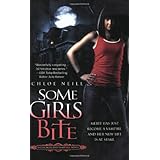
Some Girls Bite (Chicagoland Vampires, Book 1) Review

Some Girls Bite (Chicagoland Vampires, Book 1)
Average Reviews:

(More customer reviews)
I'm a first time book reviewer. I usually read a mix of romance, urban fantasy and sci-fi. I bought this book on a whim, based on the reviews I read here. I received it yesterday, and ended up staying up until 2 a.m. to finish it. It was an excellent read, fast paced, good characterization, great plot, I could not put it down. There is a nice balance of humor and lots of sexual tension between Merit and Ethan.
This author and series has a lot of promise and I will definitely buy the next book. If you like Charlaine Harris, Patricia Briggs or Illona Andrews, then you will like this one too!

Click Here to see more reviews about: Some Girls Bite (Chicagoland Vampires, Book 1)

First in a brand new series about a Chicago graduate student's introduction into a society of vampires.Sure, the life of a graduate student wasn't exactly glamorous, but it was Merit's. She was doing fine until a rogue vampire attacked her. But he only got a sip before he was scared away by another bloodsucker—and this one decided the best way to save her life was to make her the walking undead. Turns out her savior was the master vampire of Cadogan House. Now she's traded sweating over her thesis for learning to fit in at a Hyde Park mansion full of vamps loyal to Ethan "Lord o' the Manor" Sullivan. Of course, as a tall, green-eyed, four-hundred- year-old vampire, he has centuries' worth of charm, but unfortunately he expects her gratitude— and servitude. But an inconvenient sunlight allergy and Ethan's attitude are the least of her concerns. Someone's still out to get her. Her initiation into Chicago's nightlife may be the first skirmish in a war—and there will be blood.

Buy Now

Click here for more information about Some Girls Bite (Chicagoland Vampires, Book 1)

Read More...

Perfect Chemistry Review

Perfect Chemistry
Average Reviews:

(More customer reviews)
Alex Fuentes is gang member from the south side of Fairfield, and Brittany Ellis is a privileged girl from the north. Each have a status and a reputation to uphold at Fairfield High, but they also have secrets--for Alex, it's the desire to break free from the Latino Blood gang and his tough image and succeed in life. Brittany's life may look perfect from the outside, but at home, her parents are struggling to deal with Brittany's handicapped sister.

Brittany and Alex are on the opposite ends of the social scene spectrum, but that doesn't stop their chemistry teacher from making them lab partners. It's hate at first sight for both, but as they learn more about each other and slowly move beyond the stereotypes, they'll discover completely new people.

Perfect Chemistry is the classic love story of two utterly different people falling for each other, despite their initial loathing. Elkeles breathes new life into the old tale, giving it a fresh teenage perspective by interchangeably writing in both Alex and Brittany's point of view, keeping Perfect Chemistry fresh and evenly paced. The plot is realistic and sweet without being cliché, and the dialogue is perfect; gritty, and genuine. Each side is portrayed objectively, and though Alex and Brittany's relationship does move at a fast pace, their thoughts, insecurities, hang-ups, and urges all ring true and are easy for nearly any teen to identify with.

Though it is an important part of the book, the romance doesn't dominate it: strong themes of acceptance, diversity, courage, and independence are also present, making for a powerful read that boldly faces the consequences of gang life, and offers an unflinching look at how difficult it is to extricate oneself from it. Elkeles has created a riveting and strong novel with an important and relevant message and a romance hotter than any exothermic reaction.

Click Here to see more reviews about: Perfect Chemistry


Buy Now

Click here for more information about Perfect Chemistry

Read More...

The Paris Wife: A Novel Review

The Paris Wife: A Novel
Average Reviews:

(More customer reviews)
At the end of Ernest Hemingway's memoir, A Moveable Feast , he writes of his first wife, Hadley Richardson, "I wish I had died before I loved anyone but her." After their divorce, Hemingway marries three more times, each one prompt to follow, like serial wives. This is the story of the woman that loved him before he was famous.
Paula McLain researched their biographies, letters, and Hemingway's novels, culling the material to imagine a story of their charmed and battered marriage in Paris, from 1921-1926. The tortured life and tragically foreshadowed suicide of Ernest Hemingway is public knowledge, as was his legendary womanizing. McLain's novel dodges the palaver, blending the facts that are known together with credible inference, creating a plausible, informed depiction of Hemingway and Hadley's marriage--the quotidian, the famed, the halcyon, the harsh.
The author writes from Hadley's point of view, inviting the reader inside their most tender and demolishing moments. A few choice sections belong to Hemingway's perspective, urgent and telling. The narrative deftly folds in their histories--the years before they met--artfully revealing early and private woes, which ripple and sometimes hiss beneath the ardor. We get the back stories without muddled exposition; by the time it arrives at the failure of their union, readers have acquired a fluency of Hadley's nature and Hemingway's core.
Hadley sustained several painful childhood experiences that eerily parallel Hemingway's, and was a recluse and "spinster" at twenty-eight, when she met and was courted by the twenty-one-year-old Hemingway. He was a struggling, ambitious writer, home after the shock and agonies of the Great War, where he endured trauma and its aftereffects, described today as PTSD (post-traumatic stress disorder). He couldn't sleep without a light. His mother was an insufferable controller, and he didn't want to marry a woman like that.
The pliable and less progressive Hadley was a sound match for the needy, talented, and egocentric Ernest. He required a woman who would unshakably support his career. Hadley was a generous lover and devoted supporter who sacrificed her personal ambitions for Ernest. She was also playful and warm and smart, but not savvy and edgy like the emerging modern women of the 1920's.

In prose that reflects the style of the era, McLain illustrates a glittering world of élan expatriates and literati. Hadley and Ernest (and their baby, Bumby) lived in the (then) modest Latin Quarter, and soon became a vibrant part of the Left Bank artists, such as Gertrude Stein, Zelda and F. Scott Fitzgerald, Ezra Pound, James Joyce, Ford Maddox Ford, Jean Rhys, and many others. Open marriage, and mistresses living in the same house with wives, were not unheard of in this set.
Blithe talk, bottomless glasses of whiskey, and bottle after bottle of wine was the norm in their active social lives. In the mornings, the hair of the dog was the cure for the night on the town. Jaunts to Pamplona to see the bullfights were illustrated by McClain in all their gory splendor.
During this time, Hemingway wrote copiously and tirelessly, jealous of some of his peers who were already established. The germination and completion of The Sun Also Rises is covered, as well as his ruthless parody of Sherwood Anderson's work, The TORRENTS OF SPRING. Hadley loved him utterly, propped him up buoyantly, and assured him of his inevitable success. Eventually, Ernest acquired more expansive needs, and Hadley needed less, but got more than she bargained for. McClain limns their marriage as more than just a cautionary tale.
"To keep you from thinking, there was liquor, an ocean's worth at least, all the usual vices and plenty of rope to hang yourself with. But some of us, a very few in the end, bet on marriage against the odds."
This isn't standard "chick-lit" fare, nor is it cloying. I recommend this to anyone interested in the psyche of Hemingway, his first marriage, and his genesis as one of the greatest American authors of our time--from a wife's perspective.


Click Here to see more reviews about: The Paris Wife: A Novel


Buy Now

Click here for more information about The Paris Wife: A Novel

Read More...